
Introducción
The demand for portable dental equipment continues to grow because dental services are no longer limited to traditional clinics. Buyers source portable dental units for mobile dental clinics, school oral health programs, rural public health projects, temporary treatment rooms, dental education, emergency dental services, outreach events, and distributor package sales. In these use cases, the unit must be practical to move, stable in operation, easy to maintain, and suitable for repeated use in changing environments.
This buying guide explains how to evaluate a portable dental unit from a B2B procurement perspective. It also covers common product types, important features, compatibility issues, portable dental turbine unit considerations, price factors, supplier evaluation, and practical mistakes to avoid before placing sample or bulk orders.
What Is a Portable Dental Unit?
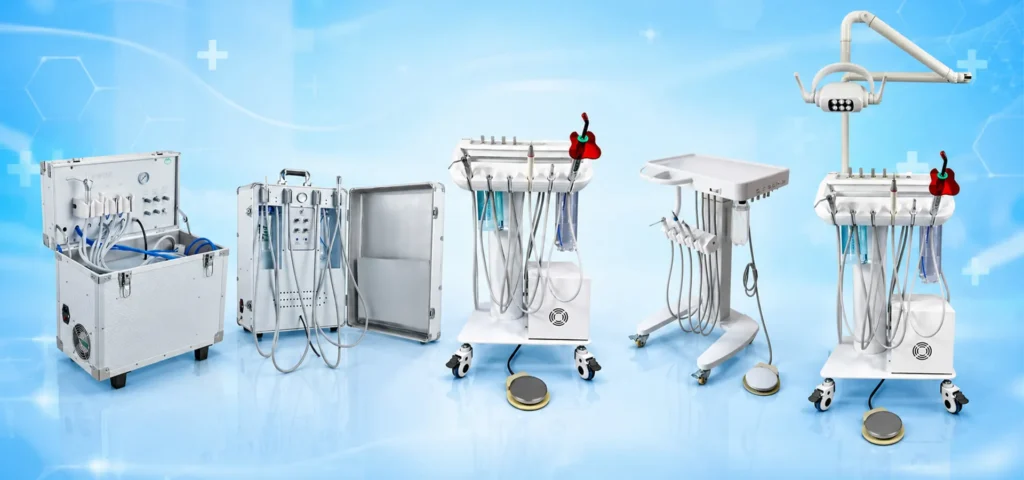
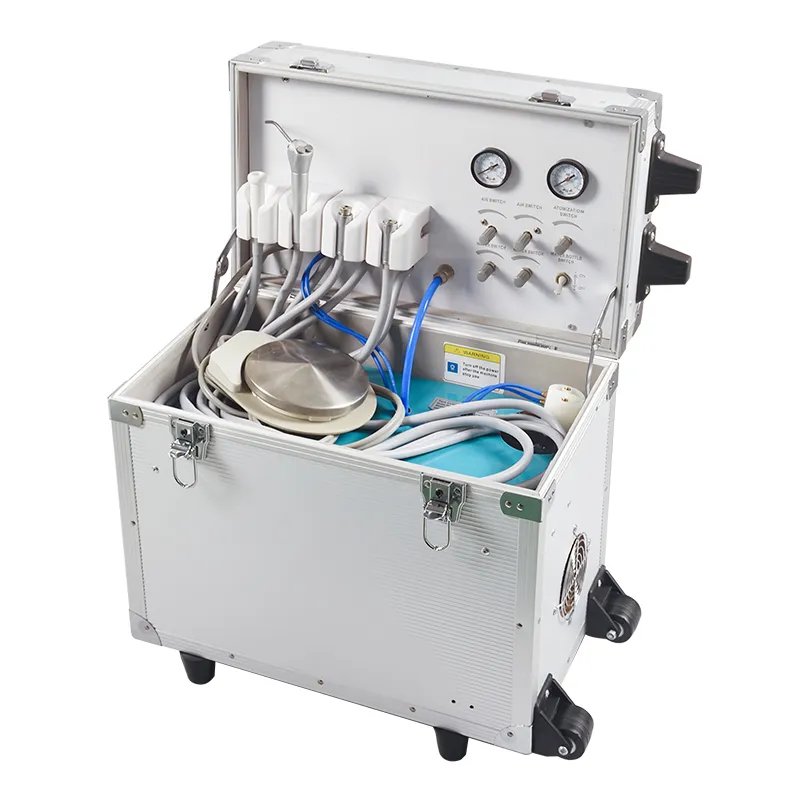
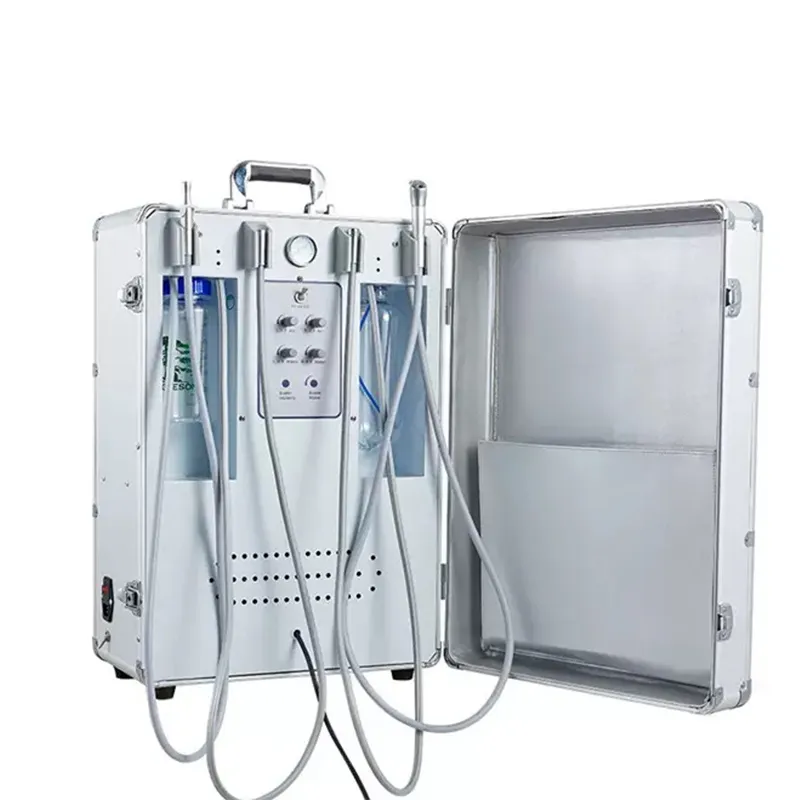
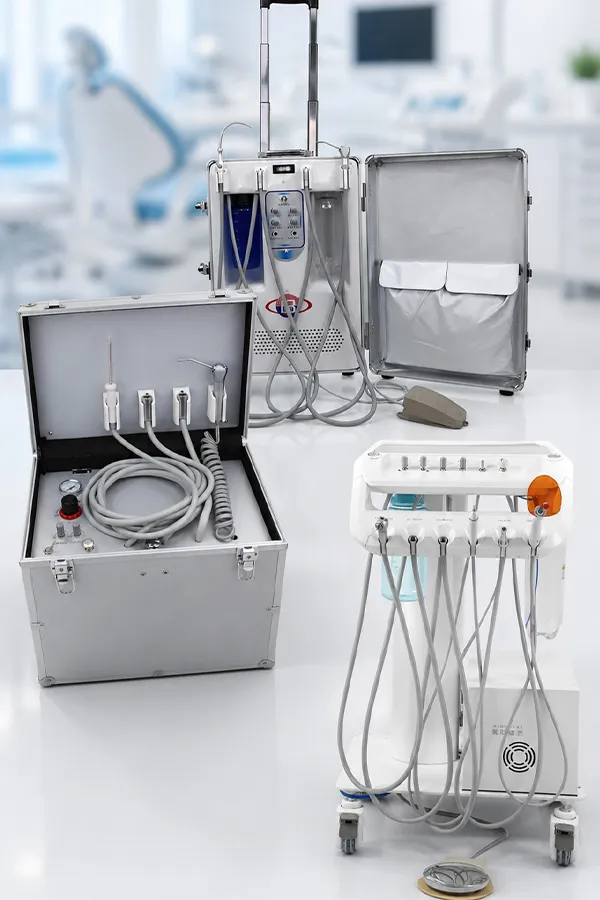
A portable dental unit is a compact dental delivery system designed to support dental treatment outside a fixed installed dental chair system. Depending on the model, it may include or connect to a compressor, water bottle, suction system, waste bottle, handpiece tubing, Air water syringe, foot control, and other working parts. Some models are built into a case for transport, while others use a cart format for easier chairside operation.
Because terminology can vary across suppliers and markets, buyers should confirm the exact model configuration before comparing quotations. A low-cost unit that requires external air and suction is not directly comparable with a self-contained unit that includes more functions. Similarly, a portable dental turbine unit may focus mainly on air-driven handpiece operation and should be evaluated based on handpiece tubing, pressure requirements, air source, water spray function, and compatibility with the broader mobile dental setup.
Portable dental units are commonly purchased for:
- Mobile dental clinics and mobile vans
- School dental screening and public health programs
- Rural outreach and temporary field treatment
- Clinic backup operation or temporary treatment rooms
- Dental education, simulation, and training centers
- Humanitarian and emergency dental service projects
- Distributor and wholesaler complete portable dental packages
Before procurement, buyers should define the clinical workflow, operating environment, expected transport frequency, accessory requirements, maintenance plan, and destination market compliance needs. These factors directly affect which type of portable dental unit is suitable.
Key Features to Evaluate
Function Integration
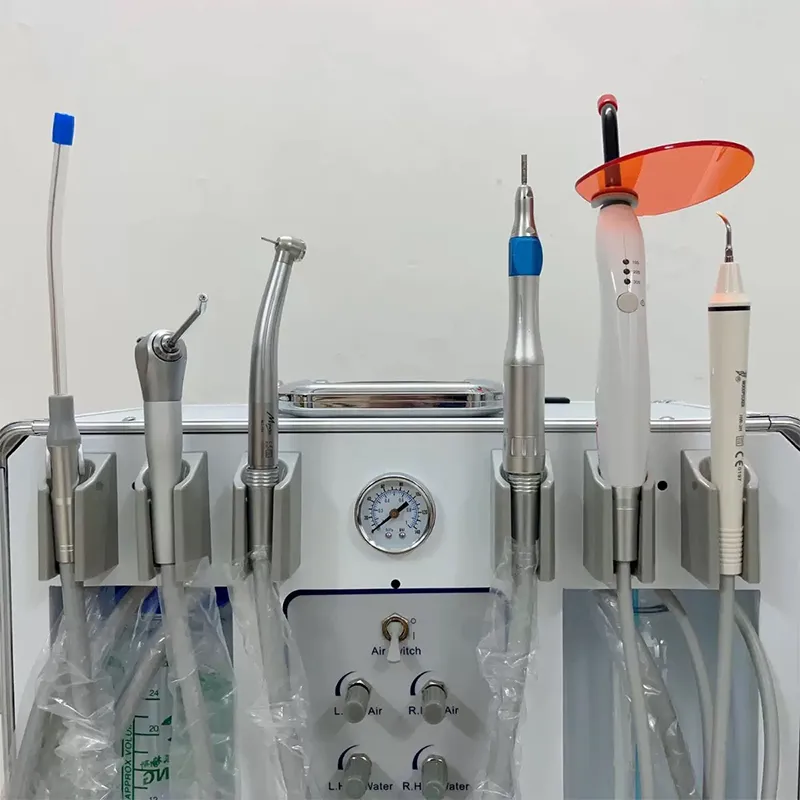
The first question is what functions the unit actually provides. A portable dental unit may include air delivery, clean water supply, suction, waste collection, high-speed handpiece tubing, low-speed handpiece tubing, syringe connection, and foot control. However, not every model includes all of these functions.
Buyers should ask the supplier to confirm:
- Whether the air source is built in or external
- Whether suction is built in or requires a separate suction unit
- Whether the unit includes a clean water bottle or reservoir
- Whether the unit includes a waste bottle or container
- Which handpiece tubing types are supported
- Whether a 3-way syringe is included
- Whether foot control is included or optional
- Which accessories are included in the quotation
This confirmation is especially important for distributors and importers. End customers often compare products only by photos, but after-sales issues usually come from missing functions, unclear accessory lists, or incompatible connections.
Air and Handpiece Performance
Air delivery is central to many portable dental unit applications. Buyers should confirm the air system by model, including whether the unit has a built-in compressor or uses an external air connection. If the product will support a portable dental turbine unit or air-driven handpiece operation, confirm the handpiece tubing type, pressure requirements, water spray support, and recommended use conditions with the supplier.
Do not assume compressor power, pressure, airflow, duty cycle, or noise level unless the supplier confirms the data for the exact model. Competitor specifications and general market examples should not be treated as Kinsun Dental specifications. For procurement accuracy, request model-specific technical information before quotation confirmation.
Water Supply and Waterline Management
Portable dental units often use a clean water bottle or reservoir. Buyers should confirm bottle capacity, bottle material, bottle fitting type, replacement bottle availability, and cleaning procedure. Waterline maintenance is also important because narrow dental waterlines can develop biofilm if they are not flushed and maintained according to proper procedures.
For public health programs, clinic chains, and institutional buyers, water management should be included in operating protocols. Ask for maintenance instructions covering water bottles, tubing, handpiece lines, and flushing procedures. A unit that is easy to clean and service can reduce downtime and improve user confidence.
Suction and Waste Handling
Some portable dental units include suction, while others require a separate suction unit. Buyers should confirm suction type, waste bottle design, filter requirements, cleaning access, and replacement parts. In mobile dentistry, suction and waste handling affect both clinical workflow and infection prevention.
For distributor package sales, it may be practical to offer a complete package that includes a portable dental unit and a portable dental suction unit. This reduces compatibility questions for end customers and can make the package easier to sell.
Portability and Structure
Portability is not only about unit size. B2B buyers should evaluate the full transport experience, including case strength, handles, wheels, internal component protection, tubing layout, bottle placement, packing strength, carton dimensions, and gross weight.
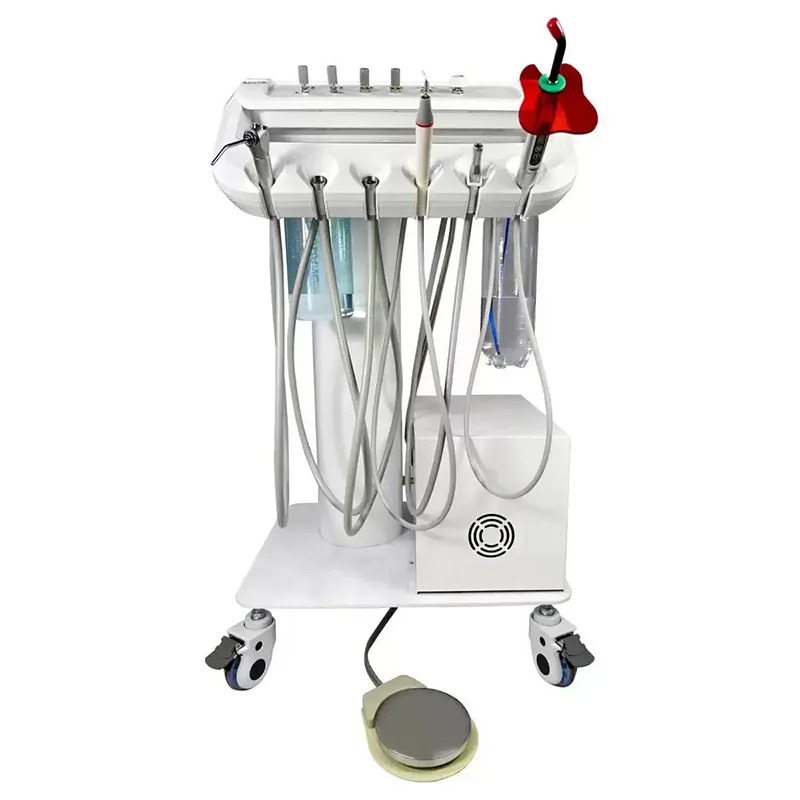
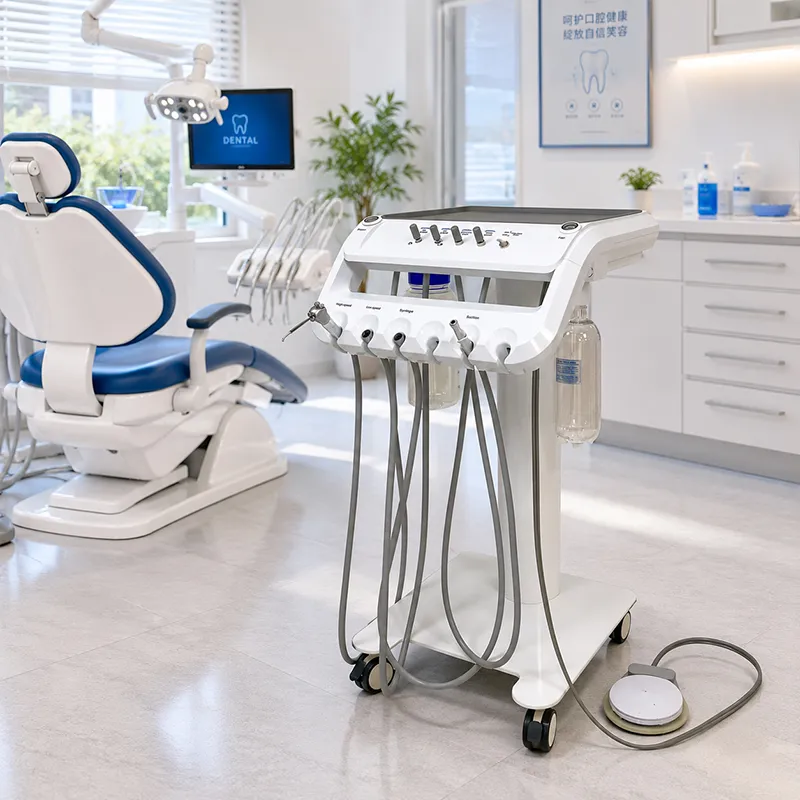
Case-type units are useful when frequent transport is required. Cart-type units may be better for semi-mobile clinics, training rooms, or temporary treatment setups where the unit is moved within a facility but not carried long distances. Buyers should match the structure to the actual working environment.
Durability and Serviceability
Portable dental units are often packed, unpacked, moved, cleaned, and operated repeatedly. Durability should be evaluated through the case or cart structure, internal layout, tubing quality, bottle fittings, connection points, and service access. A design that is easy to inspect and maintain is valuable for distributors because it reduces after-sales pressure.
Ask the supplier which spare parts are available. Common service items may include water bottles, waste bottles, bottle caps, O-rings, tubing, filters, handpiece lines, foot controls, syringe parts, and fittings. For bulk orders, buyers should consider ordering spare parts together with the main products.
Compatibilidad
Compatibility is one of the most important buying factors for a portable dental unit. Buyers should confirm whether the unit works with selected portable dental chairs, suction units, dental lights, stools, trolleys, handpieces, air scalers, curing lights, foot controls, water bottles, and tubing. Local power requirements and plug requirements should also be confirmed for the destination market.
Distributors should avoid building product packages from unrelated suppliers without confirming compatibility. A complete package may look attractive in a catalog, but mismatched tubing, voltage, accessory connections, or packing standards can create operational problems after delivery.
Documentation and Import Readiness
Importers, hospitals, government buyers, and clinic chains may request manuals, packing lists, invoices, product photos, warranty terms, and available certification documents. Medical electrical safety and local import requirements can vary by country, so buyers should confirm available documentation and destination market requirements before purchase.
Types of Portable Dental Units Available
Portable dental units are not all designed for the same use case. The table below provides a practical comparison framework for procurement teams.
| Tipo | Typical Characteristics | Best-Fit Buyers |
|---|---|---|
| Desktop portable dental unit | It is very compact and does not have a built-in air compressor; it needs to be connected to an air compressor for use. | Low-budget clinics, academic conferences, mobile healthcare |
| Case-type portable dental unit | Suitcase-style design for compact storage and transport | Field service teams, outreach programs, importers testing demand |
| Cart-type mobile dental unit | Cart structure with easier chairside positioning and possible larger working layout | Semi-mobile clinics, dental schools, training rooms, temporary treatment rooms |
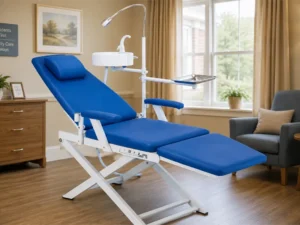
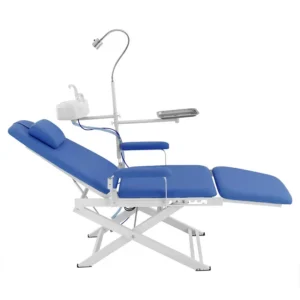
| Complete mobile dental package | Portable dental unit supplied with chair, suction unit, light, stool, trolley, handpieces, or accessories | Distributors, wholesalers, public health projects, clinic chains |
A government rural outreach project may prioritize self-contained operation, durability, spare parts, and bulk supply. A dental school may prefer cart-type units for training rooms. A distributor may choose several configurations to cover different price points and market segments.
Important Buying Factors
Product Quality
For portable dental equipment, quality issues are often exposed during repeated movement and field operation, not only during initial testing.
Before a bulk order, buyers should request clear product photos, accessory lists, packaging details, and model-specific information. If possible, order a sample for evaluation before committing to a large distributor launch or public procurement project.
Supplier Reliability
Supplier reliability affects far more than the first shipment. B2B buyers need consistent communication, stable product availability, clear quotation details, export documentation, spare parts supply, and after-sales support. A lower unit price may become expensive if the supplier cannot support repeat orders or provide replacement parts.
Evaluate whether the supplier understands distributor, importer, wholesaler, clinic chain, and government procurement requirements. The ability to discuss MOQ, lead time, packaging, shipping, documentation, OEM/ODM, and spare parts is a strong signal of B2B readiness.
OEM and ODM Capability
OEM and ODM support is important for distributors building private label product lines. Customization may include logo, packaging, case color, accessory configuration, product combinations, and documentation requirements. Buyers should confirm which customizations are available, what MOQ applies, and how customization affects lead time.
Private label buyers should also request packaging artwork requirements, sample approval process, and final product confirmation steps before mass production.
MOQ
Minimum order quantity can vary by model, stock status, customization, and order plan. Some buyers need low MOQ for market testing, while others need bulk pricing for distributor resale or government programs. Instead of asking only for the lowest MOQ, buyers should explain the sales channel, expected repeat order plan, and preferred configuration. This helps the supplier recommend a practical purchasing structure.
Lead Time
Lead time depends on model, quantity, customization, stock status, and production schedule. For public health projects or clinic openings, delivery timing can be as important as unit cost. Buyers should confirm lead time before payment and include packaging, inspection, shipping, and customs clearance time in the project schedule.
Warranty and After-Sales Support
You should also ask how after-sales support is handled for accessories, replacement parts, maintenance questions, and technical issues. For distributors, clear after-sales planning protects local customer relationships and reduces service risk.
Packaging and Logistics
Portable dental units may be shipped by express, air freight, sea freight, or combined shipment with other dental equipment. Packaging strength matters because internal components, bottles, fittings, and tubing must be protected during transport. Buyers should confirm carton dimensions, gross weight, packing method, spare parts packing, and container loading considerations when planning bulk orders.
Destination Market Requirements
Power supply, plug type, documentation, labeling, and import requirements may differ by country. Buyers should confirm local requirements before ordering. For example, some markets require 220-240V compatibility, specific plug types, manuals, invoices, packing lists, or available certificates. Exact compliance requirements should be confirmed by the buyer according to the destination market.
Price Considerations
Portable dental unit pricing depends on product type, function integration, component quality, included accessories, OEM/ODM requirements, quantity, packaging, shipping method, and destination country. Exact pricing should be requested from the supplier based on the selected model and order details. This guide does not provide fixed price ranges because unconfirmed pricing can mislead buyers and create inaccurate procurement expectations.
Main cost drivers include:
- Built-in compressor or external air connection design
- Built-in suction or separate suction requirement
- Handpiece tubing configuration
- Water and waste bottle design
- Case or cart structure
- Included foot control, syringe, tubing, and accessories
- Packaging requirements
- OEM logo, color, or packaging customization
- Spare parts kits
- Order quantity and repeat purchase plan
- Shipping method and destination
For bulk purchasing, buyers should evaluate total landed cost instead of only unit price. Total landed cost may include product cost, packing, inland logistics, export charges, freight, import duties, taxes, customs clearance, local delivery, spare parts, and after-sales service cost. A slightly higher unit price may be more competitive if the product has better configuration, stronger packaging, clearer documentation, and more stable after-sales support.
Distributors should also consider product positioning. A basic portable dental turbine unit may serve price-sensitive customers, while a self-contained portable dental unit or complete mobile package may serve clinics, institutions, and public health projects that require broader function integration.
Cómo elegir el proveedor adecuado
Review Manufacturing Capability
A suitable supplier should understand portable dental equipment construction, component sourcing, assembly, inspection, packaging, and repeat production.
Evaluate Export Experience
Export experience is important for importers and distributors because international orders require clear documents, careful packing, shipping coordination, and communication across time zones. Suppliers with export experience can usually support invoices, packing lists, product photos, shipping details, and buyer-specific documentation more efficiently.
Confirmar control de calidad
Quality control should cover function checks, accessory completeness, packaging condition, and model consistency. For portable dental units, it is also important to check connections, bottles, tubing, foot controls, and working functions before shipment. Buyers placing bulk orders should request pre-shipment confirmation and clarify inspection expectations.
Ask About Technical Support
Technical support helps buyers solve installation, operation, maintenance, and after-sales questions. Ask whether the supplier can provide manuals, photos, videos, spare parts guidance, and troubleshooting support. For distributors, this support can reduce local service burden.
Check Product Range
Buyers who need complete portable dental packages benefit from a supplier with related products, such as portable dental chairs, portable dental suction units, dental trolleys, dental lights, stools, handpieces, air scalers, curing lights, tubing, and accessories. A broader product range can reduce supplier fragmentation and simplify compatibility planning.
Confirmar el proceso OEM/ODM
Ask about logo options, packaging design, color customization, accessory configuration, MOQ, sample approval, and production lead time. Clear OEM/ODM communication helps buyers avoid delays and mismatched expectations.
Why Consider Kinsun Dental
Kinsun Dental is a professional manufacturer and supplier of dental chair parts, dental instruments, and portable dental equipment. The company has over 10 years of experience in the dental industry and serves B2B customers including dental distributors, importers, wholesalers, government procurement projects, and dental clinic chains.
For portable dental unit buyers, Kinsun Dental’s product range is relevant because it includes portable dental units, portable dental chairs, portable dental suction units, dental trolleys, and related dental instruments and dental accessories. This range can help distributors and project buyers build complete mobile dental unit packages with fewer supplier coordination problems.
Kinsun Dental’s procurement advantages include factory direct pricing, OEM and ODM services, bulk production capability, fast global shipping, stable quality control, low MOQ discussion, and export experience. These advantages are most useful when buyers need repeat supply, distributor pricing, private label options, bulk order planning, and practical support for international shipment.
As with any dental equipment purchase, buyers should confirm exact specifications, available documents, accessory lists, voltage options, packaging, warranty terms, and lead time by model before order confirmation.
Procurement Decision Framework
Use the following framework before sending an inquiry or approving a quotation.
| Decision Area | What to Decide | Why It Matters |
|---|---|---|
| Use scenario | Mobile clinic, school program, training room, temporary clinic, distributor resale, or government project | Determines structure, function, durability, and accessory needs |
| Product type | Self-contained, case-type, cart-type, chairside delivery, turbine-focused, or complete package | Prevents configuration mismatch |
| Function requirements | Air, water, suction, syringe, handpiece tubing, foot control, waste collection | Ensures the unit supports the intended workflow |
| Compatibilidad | Chair, suction unit, handpieces, tubing, lights, trolley, local voltage | Reduces after-sales issues |
| Maintenance | Bottles, filters, O-rings, tubing, cleaning access, spare parts | Supports long-term operation |
| Documentation | Manual, packing list, invoice, warranty terms, available certificates | Supports import and institutional procurement |
| Commercial terms | MOQ, lead time, sample order, bulk pricing, OEM/ODM | Aligns supplier offer with purchasing plan |
| Logistics | Packing, carton size, gross weight, shipping method, destination | Controls landed cost and delivery timing |
This framework is useful for both first-time buyers and experienced distributors. It moves the discussion away from vague price comparison and toward a more accurate procurement decision.
Preguntas frecuentes
A portable dental unit is a compact dental delivery system used when a fixed dental operatory is not practical. Depending on the model, it may support air supply, water supply, suction, handpiece connections, syringe function, waste collection, and instrument control.
Common B2B buyers include dental distributors, importers, wholesalers, clinic chains, mobile dental service providers, dental schools, hospitals, government procurement departments, and public health programs.
The terms often overlap, but buyers should confirm the exact configuration. A mobile dental unit may refer to a portable delivery unit, a cart-based system, or a complete mobile dental package with chair, suction, light, and accessories.
Buyers should confirm air delivery, water supply, suction, waste bottle, handpiece tubing, syringe function, foot control, power requirements, accessories, spare parts, and cleaning procedure by model.
Some models are self-contained, while others require external air, external suction, or separate accessories. Buyers should confirm the exact configuration before comparing prices or placing orders.
Yes, portable dental units are often used with portable dental chairs. However, compatibility should be confirmed before purchase, especially for chair height, tubing layout, suction, light, stool, and package accessories.
Common spare parts include water bottles, waste bottles, bottle caps, O-rings, tubing, filters, handpiece lines, foot controls, syringe parts, and fittings.
Price is affected by product type, built-in functions, component configuration, included accessories, OEM/ODM requirements, order quantity, packaging, shipping method, and destination country.
MOQ depends on model, stock status, customization, and order plan. Kinsun Dental can discuss low MOQ options and bulk order requirements based on buyer needs.
Lead time depends on product model, order quantity, customization, stock status, and production schedule. Buyers should confirm lead time before order confirmation, especially for project-based purchasing.
Yes. Kinsun Dental supports OEM and ODM services for B2B buyers. Possible topics include logo, packaging, case color, accessory configuration, and product package combinations, depending on order details.
Importers may request manuals, packing lists, invoices, product photos, warranty terms, available certificates, and shipping documents. Required documentation should be discussed before order placement.
Kinsun Dental supplies portable dental equipment and related dental products for B2B buyers. The company offers factory direct pricing, OEM/ODM services, bulk production capability, export experience, stable quality control, low MOQ discussion, and global shipping support.
Conclusión
Choosing a portable dental unit requires more than comparing product photos and unit prices. Buyers should evaluate the intended use scenario, function integration, air and water systems, suction, handpiece compatibility, portability, cleaning access, spare parts, documentation, power requirements, packaging, and supplier reliability.
For distributors and importers, the best purchasing decision is usually the unit or package that can be sold, supported, reordered, and maintained consistently. For clinic chains, schools, hospitals, and government projects, the right choice is the configuration that matches the operating environment and service workflow. If a portable dental turbine unit is part of the requirement, confirm whether it is a standalone handpiece support solution or part of a broader portable dental unit package.
Kinsun Dental can support B2B buyers with portable dental units, portable dental chairs, portable suction units, dental trolleys, dental instruments, OEM/ODM options, bulk order planning, and export support. Buyers should provide target quantity, destination country, application scenario, required functions, accessory needs, and documentation requirements to receive an accurate quotation.