

The seat surface is one of the most frequently used and cleaned parts of a dental stool. During a normal working day, it is exposed to repeated sitting, body movement, friction from clothing, moisture, perspiration and regular wiping with cleaning products. For this reason, dental stool upholstery materials should not be selected by color and appearance alone.
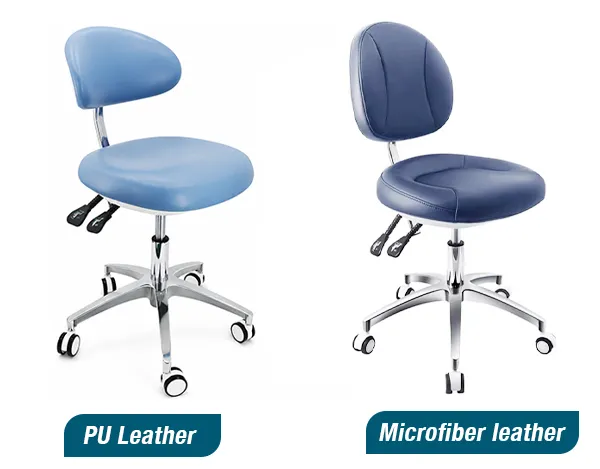
Two materials commonly considered for professional dental stools are medical-grade PU upholstery and microfiber leather. Both can provide a smooth, professional appearance, but they differ in construction, cleanability, breathability, durability, price and expected service life.
This guide explains how these two dental stool seat materials differ, why ordinary furniture-grade PU and low-cost PVC should not be treated as equivalent alternatives, and how clinics, distributors and OEM buyers can select the right upholstery for their applications.
Why Dental Stool Upholstery Material Matters
Dental professionals may remain seated for long procedures while frequently leaning, rotating or moving around the patient chair. These movements create repeated pressure and friction on the seat surface. At the same time, clinics need to clean the stool regularly without damaging its upholstery.
A suitable dental stool material should provide a practical balance of:
- Surface cleanability
- Resistance to liquid penetration
- Compatibility with approved cleaning products
- Comfort during prolonged sitting
- Resistance to abrasion and tearing
- Flexibility under repeated movement
- Color stability
- Resistance to premature cracking or peeling
- Reasonable replacement cost
The upholstery is only one part of a professional stool, but it directly influences daily maintenance and user experience. Buyers should also examine the cushion, gas lift, base, casters and adjustment mechanisms when comparing professional dental stools.
Material terminology can also be confusing. A supplier may describe a product simply as “PU leather,” even though PU upholstery is available in many different grades. A low-cost material made for occasional household use should not be assumed to perform like upholstery selected for frequently used clinical seating.
What Is Medical-Grade PU Upholstery?
PU stands for polyurethane. In upholstery applications, PU synthetic leather is generally produced by applying a polyurethane surface layer to a textile or nonwoven backing. The formulation, backing, coating thickness and finishing process determine how the final material performs.
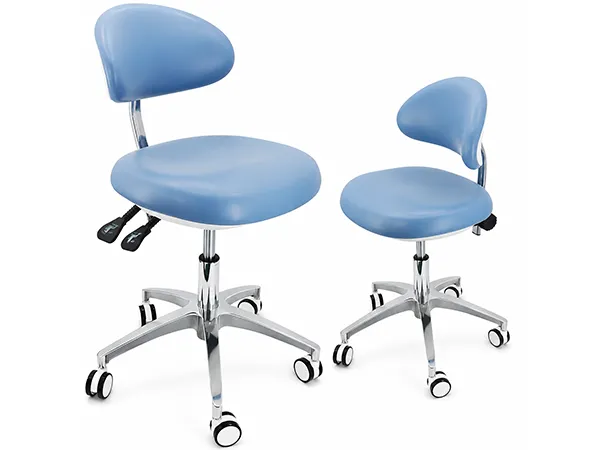
The term “medical-grade PU” is commonly used for PU upholstery developed or selected for professional healthcare furniture. It usually emphasizes properties such as:
- A relatively smooth and nonporous surface
- Resistance to water and common stains
- Easy wiping and routine maintenance
- Flexibility and a soft surface feel
- Compatibility with specified cleaning products
- A professional clinical appearance
However, “medical-grade” should not be treated as proof that every PU material can tolerate every disinfectant. Buyers should still ask the supplier for material specifications, test information and cleaning instructions.
Kinsun uses approximately 1.2 mm medical-grade PU upholstery on selected dental stool models. The additional thickness supports better durability than the thin furniture PU commonly found on some low-cost stools. Actual performance still depends on the coating formulation, backing material, frequency of use and cleaning method.
The Main Advantage of PU: A Seamless Dental Stool Surface
One of the most important advantages of Kinsun’s PU dental stool upholstery is not only the material itself, but also the way the cushion is processed.
With the production method used for selected Kinsun PU stools, the upholstery can be formed around the cushion without exposed stitching across the main sitting surface. This creates a continuous seat with few areas where dirt or cleaning residue can collect.
A seamless dental stool upholstery surface provides several practical benefits:
- The operator can wipe across the seat without following recessed stitch lines.
- Liquid is less likely to collect in exposed seams.
- There are fewer narrow areas that require detailed manual cleaning.
- The seat can be cleaned more quickly between working sessions.
- The appearance is simple and suitable for a modern clinic.
It is important to understand that PU leather is not automatically seamless. Seamlessness is the result of the cushion design and upholstery process. A PU cover made from several cut panels may still require stitching. In this comparison, “seamless PU” refers specifically to the construction used on relevant Kinsun dental stools.
For a busy clinic where surfaces are wiped repeatedly every day, this construction can be more useful than choosing an expensive material that has complicated seams or decorative folds.
Other Advantages of Medical-Grade PU Dental Stool Upholstery
Easy Routine Cleaning
A smooth PU surface is easy to wipe when the correct cleaner is used. Because the material does not have the open weave of conventional fabric, routine moisture and surface residue are less likely to enter the cushion.
This makes medical-grade PU a practical option for dentist stools, dental assistant stools and other seating used in high-turnover environments.
Good Initial Softness
PU can provide a soft, slightly elastic touch without the stiffness sometimes associated with inexpensive vinyl upholstery. Combined with suitable high-elasticity foam, it creates a comfortable seat for general clinical use.
The upholstery alone does not determine comfort. Foam density, cushion thickness, seat contour and pressure distribution are equally important. Buyers comparing stool comfort should evaluate the complete cushion rather than only pressing the surface material with a finger.
Wide Choice of Colors
PU upholstery can be produced in a broad range of colors. This allows dental equipment distributors and clinic projects to match stools with dental chairs, cabinets or corporate branding.
OEM color matching may be available depending on order quantity, model and material availability.
Competitive Purchase Cost
Medical-grade PU normally costs less than premium microfiber leather. It is therefore suitable for:
- Dental clinics purchasing multiple stools
- Distributors building a cost-effective product range
- Dental chair manufacturers adding a matching operator stool
- Projects that require several upholstery colors
- Buyers who expect to update the seat after several years
For buyers working within a defined price range, PU usually provides a practical balance between appearance, hygiene and initial cost.
Limitations and Aging of PU Upholstery
The main limitation of conventional PU dental stool upholstery is aging.
Repeated pressure, flexing, perspiration, humidity, heat and cleaning chemicals gradually affect the coating. Over time, the surface may become less flexible and begin to show:
- Fine cracks
- Hardening
- Peeling
- Surface flaking
- Loss of gloss
- Discoloration
- Separation between the coating and backing
PU degradation is sometimes associated with hydrolysis, a process in which moisture contributes to the breakdown of susceptible polymer structures. The rate varies considerably among different PU formulations. It is therefore inaccurate to assume that all PU upholstery has the same resistance to humidity or the same lifespan.
Based on Kinsun’s experience with frequently used dental stools, medical-grade PU upholstery commonly provides approximately two to three years of practical service. This is an estimated working range rather than a fixed warranty. A lightly used stool cleaned with compatible products may last longer, while intensive use or unsuitable chemicals may shorten its life.
A stool seat should be inspected regularly. Once the surface begins peeling or develops cracks that cannot be cleaned effectively, replacing the cushion or upholstery is generally more practical than continuing to use a damaged surface.
What Is Microfiber Leather?
Microfiber leather is a higher-performance type of synthetic leather. Although it is often presented as a separate category from ordinary PU leather, most microfiber synthetic leather also contains polyurethane.
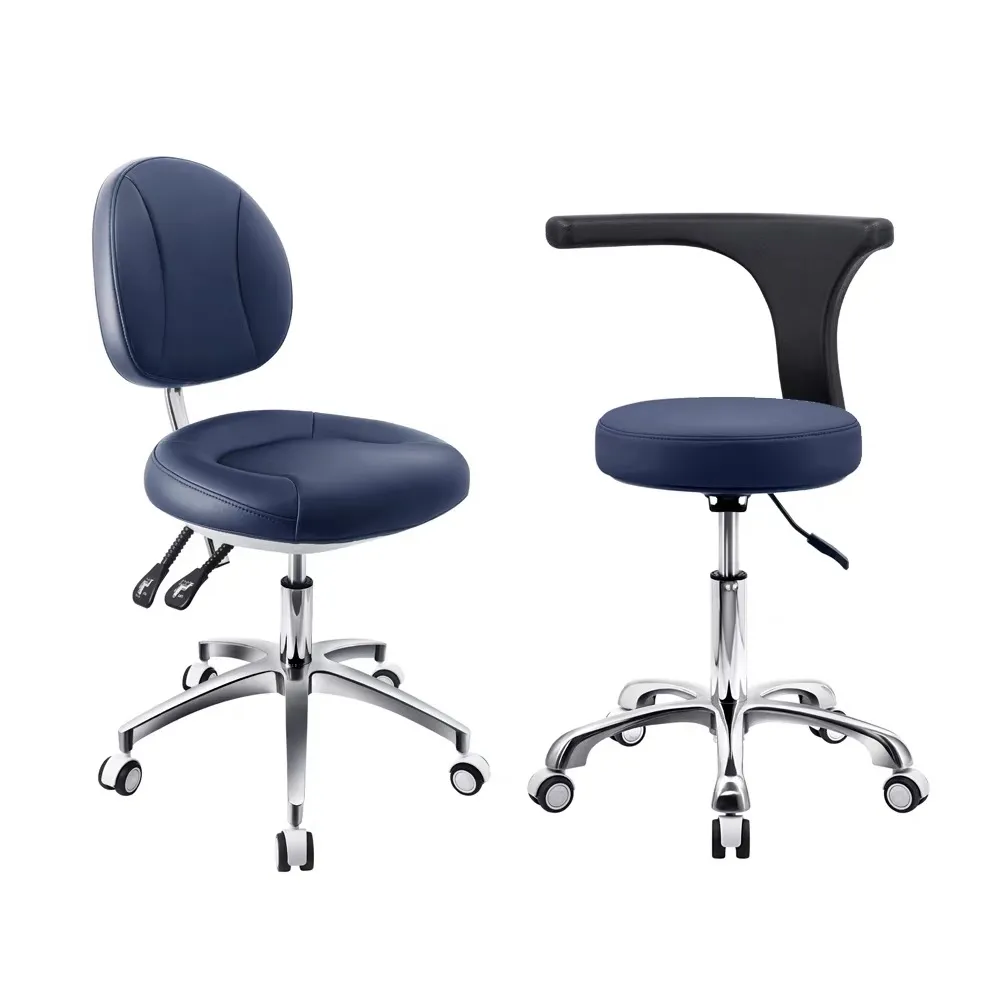
Its structure usually combines:
- A dense, three-dimensional base made from very fine polyester or nylon fibers
- PU resin impregnated into or applied to the fiber structure
- A finished surface layer that provides color, texture and protection
The microfiber network gives the material more internal structure than conventional PU leather with a basic textile backing. This helps explain why good-quality microfiber leather generally performs better in tensile strength, tear resistance, repeated flexing and long-term wear.
The exact performance depends on fiber density, PU formulation, surface finish and production quality. A product should not be considered premium simply because the seller uses the word “microfiber.”
Advantages of Microfiber Leather for Dental Stools
Better Wear and Tear Resistance
Dental professionals do not sit completely still. They repeatedly change position, rotate around the patient and push the stool across the floor. Clothing also rubs against the front and sides of the cushion.
The dense fiber structure of microfiber leather generally provides better resistance to this repeated mechanical stress. Compared with conventional PU upholstery, it is less likely to lose its structural integrity quickly under similar working conditions.
This makes a microfiber leather dental stool suitable for intensive use and buyers who prioritize long-term durability.
Longer Practical Service Life
High-quality microfiber leather is usually more resistant to cracking, peeling and deformation than conventional PU upholstery. It does not mean that the material never ages, but it commonly maintains its appearance and flexibility for longer.
The actual service life depends on:
- Material grade and thickness
- Frequency of use
- User movement
- Clinic temperature and humidity
- Exposure to perspiration
- Type and concentration of cleaning products
- Cleaning frequency
- Quality of the stitching and cushion construction
Because of its higher purchase price, microfiber is best evaluated through total ownership cost rather than initial price alone. If the upholstery remains usable for longer and requires fewer replacements, it may offer better long-term value for clinics and distributors.
Improved Breathability
Microfiber leather usually has better water-vapor transmission than ordinary PU upholstery because of its fine fiber base and microporous structure. In practical terms, this can make the seat feel less hot or sticky during prolonged sitting.
Breathability still varies according to the surface coating. A very thick or highly sealed finish may reduce moisture transmission. Nevertheless, a well-made microfiber seat generally provides better thermal comfort than a conventional sealed PU surface.
Dental hygienists and operators who sit for extended procedures may appreciate this difference. Seat shape and working posture remain equally important. For example, users considering an open hip position can read the guide to choosing the best saddle chair for a dental hygienist.
Soft, Premium Surface Feel
Microfiber leather can provide a dense, soft and natural surface texture. It often feels less synthetic than standard PU and maintains this feel for longer when correctly maintained.
This makes it appropriate for premium dental stools, clinic projects and OEM product lines where appearance and tactile quality are important purchasing factors.
Why Microfiber Dental Stool Upholstery Usually Has Seams
Microfiber leather is normally supplied as a flexible sheet material. To fit it closely around a contoured or saddle-shaped cushion, manufacturers cut the material into panels and sew the panels together by hand.
The stitching serves practical purposes:
- It helps the upholstery follow complex cushion curves.
- It controls tension across the seat.
- It reduces uncontrolled folds.
- It keeps the cover stable around the foam.
- It can reinforce the edge and shape of the cushion.
The resulting seat can look more tailored and premium, but it usually contains visible stitch lines. These seams slightly increase the cleaning work because dust, moisture or cleaning residue can enter the recessed areas around the thread.
This does not mean that microfiber leather itself is difficult to wipe. Most of the surface remains straightforward to clean. The difference is that the operator should pay additional attention to the stitched areas instead of wiping only the flat center of the seat.
The trade-off is therefore clear: microfiber offers greater comfort and durability, while seamless PU provides a simpler surface for fast routine cleaning.
Medical-Grade PU vs Microfiber Leather
| Feature | Medical-Grade PU Upholstery | Microfiber Leather |
|---|---|---|
| Basic structure | PU coating applied to a textile or nonwoven backing | Dense microfiber base combined with PU resin and a finished surface |
| Kinsun seat construction | Can be formed without exposed stitching on the main seat surface | Usually requires cut panels and manual stitching |
| Daily cleanability | Very easy to wipe because of the continuous surface | Surface is easy to wipe, but seams require additional attention |
| Liquid resistance | Good surface resistance when the coating remains intact | Generally good, but liquids should not be left around seams |
| Breathability | Relatively limited | Usually better due to the microfiber structure |
| Long-session comfort | Suitable for normal clinical use | Generally cooler and more comfortable for prolonged sitting |
| Abrasion resistance | Adequate when a suitable medical-grade material is used | Usually higher |
| Tear resistance | Depends heavily on coating and backing quality | Generally stronger due to the dense fiber network |
| Aging | May eventually harden, crack or peel | Usually resists premature cracking and peeling better |
| Estimated lifespan | Approximately 2–3 years based on Kinsun’s practical product experience | Normally longer than conventional PU under comparable conditions |
| Initial cost | Lower | Higher |
| Best suited for | Buyers prioritizing seamless cleaning and cost control | Buyers prioritizing comfort, durability and long-term value |
The table describes typical performance rather than a universal standard. Buyers should compare actual material samples and specifications before placing a bulk order.
Why Kinsun Does Not Select Furniture-Grade PU or Ordinary PVC
Some inexpensive dental stools use ordinary furniture-grade PU or basic PVC to reduce production cost. These materials may look attractive when the stool is new, but appearance alone does not indicate how the surface will perform after repeated use and cleaning.
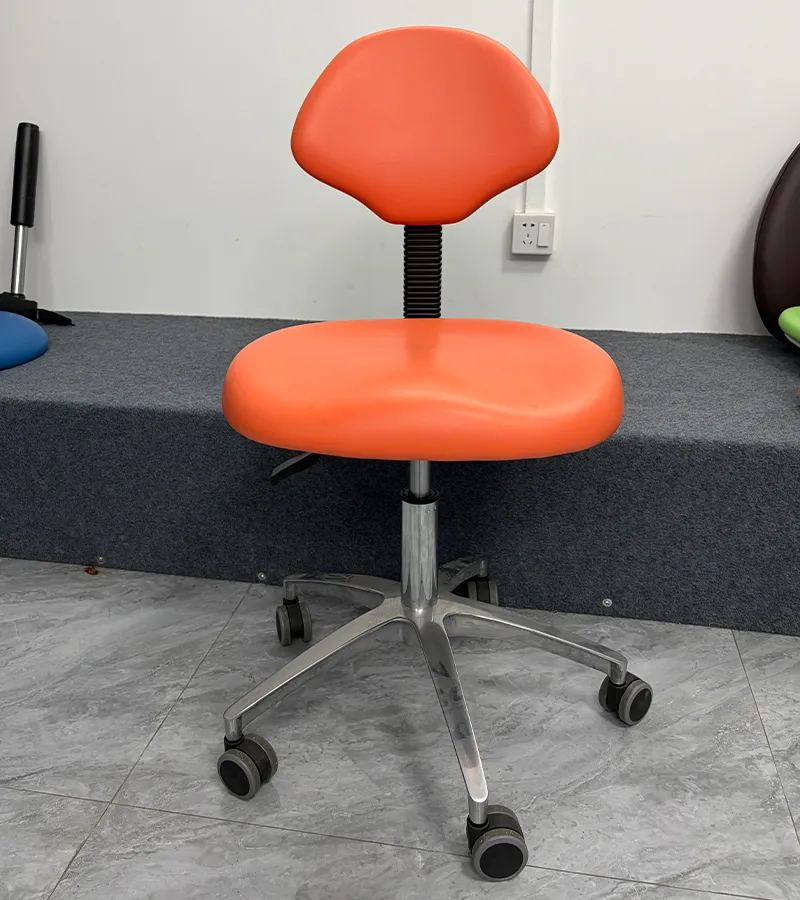
Furniture-grade PU is usually developed for domestic sofas, dining chairs or decorative seating. These products may experience lighter use and less frequent chemical cleaning than a professional dental operator stool. When used in a clinic, a low-grade PU surface may begin to crack, peel or separate earlier than expected.
Basic PVC upholstery is also common on low-price seating. It can offer water resistance and a low initial cost, but inexpensive formulations may feel stiff, provide limited breathability or lose flexibility over time.
This does not mean that every PVC or vinyl upholstery is low quality. High-performance healthcare vinyl products exist and can provide excellent cleanability and chemical resistance. However, material specifications vary widely, and a generic “PVC leather” description does not guarantee clinical performance.
Kinsun’s current material strategy focuses on selected medical-grade PU and microfiber leather rather than ordinary PVC or furniture-grade PU. This gives customers two clearer options:
- Medical-grade PU for seamless cleaning and cost efficiency
- Microfiber leather for greater comfort and long-term durability
Buyers should be cautious when comparing quotations. A very low dental stool price may reflect differences in upholstery grade, coating thickness, foam quality, gas lift, base or caster configuration—not merely a lower supplier margin.
How to Choose the Best Upholstery Material for a Dental Stool
There is no single best dental stool upholstery material for every clinic. The right choice depends on working conditions and purchasing priorities.
Choose Medical-Grade PU When:
- Fast surface cleaning is a priority.
- The clinic prefers a seamless seat.
- The stool will be wiped frequently.
- The purchasing budget is limited.
- Multiple colors are required.
- The buyer accepts a shorter upholstery replacement cycle.
- The stool is intended for general clinical or laboratory use.
Choose Microfiber Leather When:
- The user sits for long treatment sessions.
- Breathability and surface feel are important.
- The stool will receive intensive daily use.
- The buyer prioritizes abrasion and tear resistance.
- A premium product position is required.
- The project values longer service life over the lowest initial cost.
- Staff can give stitched areas additional attention during cleaning.
The user’s role should also be considered. A dentist stool, hygienist stool and assistant stool may have different seat heights, support structures and usage patterns. Our comparison of a dentist stool vs dental assistant stool explains how these roles affect stool selection.
What B2B Buyers Should Ask the Supplier
The words “PU” and “microfiber” are not enough to evaluate quality. Distributors, dental chair manufacturers and clinic procurement teams should request more specific information.
Ask the supplier:
- Is the upholstery medical-grade or furniture-grade?
- What is the material thickness?
- Is the working surface seamless or stitched?
- Which cleaning products are compatible with the upholstery?
- Has the material been tested for abrasion?
- Is hydrolysis resistance information available?
- Does the supplier provide colorfastness or tear-strength data?
- Is the quoted material PU, microfiber leather or ordinary PVC?
- Can a material or finished-stool sample be tested before a bulk order?
- Can the seat cushion or upholstery be replaced separately?
- Are custom colors available?
- Will future batches use the same upholstery specification?
For distributors, consistency between batches is especially important. A sample may perform well, but it provides limited value if later orders use a thinner coating or different backing.
The upholstery should also be evaluated together with the stool’s structure. Buyers can use the complete dental stool buying guide to compare seat type, height range, back support, foam, base and mobility.
How to Clean and Extend the Life of Dental Stool Upholstery
Correct maintenance can help both PU and microfiber dental stool upholstery last longer.
Follow the Material Instructions
Use only cleaners approved for the specific upholstery. Do not assume that every PU or microfiber material can tolerate the same concentration of alcohol, bleach, hydrogen peroxide or other disinfectants.
The chemical concentration and required contact time both matter. Using more product or leaving it on the seat longer does not necessarily improve cleaning and may damage the coating.
Remove Cleaner Residue When Required
Some products leave residue that gradually affects the surface or attracts dirt. Follow the cleaner and upholstery manufacturers’ instructions regarding rinsing and drying.
Do Not Allow Liquid to Remain in Seams
For microfiber leather stools, inspect stitch lines and recessed edges after cleaning. Remove remaining moisture with a soft cloth instead of allowing it to collect around the thread.
Avoid Abrasive Tools
Do not scrub the seat with metal brushes, rough pads or abrasive powder. These tools can scratch the protective surface and make future cleaning more difficult.
Prevent Mechanical Damage
Dental instruments, keys, belt hardware and sharp clothing accessories can puncture or scratch upholstery. Once the protective coating is broken, moisture may reach the inner structure more easily.
Inspect the Seat Regularly
Look for:
- Cracks
- Peeling
- Loose stitching
- Open seams
- Permanent stains
- Hardened areas
- Separation around the cushion edge
Damaged upholstery should be repaired or replaced before the affected area becomes larger.
Mobility components also affect upholstery life indirectly. An unstable or poorly rolling stool may cause the user to twist excessively when moving. Learn how to choose the right casters for dental stools when evaluating the complete product.
Kinsun Dental Stool Upholstery Options
Kinsun Dental supplies dental stools for clinics, dental distributors, dental chair manufacturers, repair companies and OEM buyers. Depending on the stool model and project requirements, customers can discuss medical-grade PU or upgraded microfiber leather upholstery.
Medical-grade PU is suitable for buyers who want a clean, continuous surface, competitive price and convenient daily maintenance. Microfiber leather is recommended for customers seeking greater breathability, a premium touch and longer-lasting upholstery.
Other stool options may include:
- Operator, assistant and saddle-style seats
- Different gas-lift heights
- Backrests and arm supports
- Multiple base styles
- 50 mm or 60 mm casters
- Upholstery color selection
- Logo and packaging customization
- Mixed purchasing with dental equipment and chair parts
Explore the complete range of Kinsun dental stools, or contact our team with your preferred stool type, upholstery material, color, quantity and target market.
Frequently Asked Questions
Medical-grade PU and microfiber leather are both suitable, but they serve different priorities. PU is a practical option for clinics that want seamless dental stool upholstery and quick cleaning. Microfiber leather is generally better for breathability, comfort, wear resistance and longer service life.
Yes, provided that a suitable professional-grade material is used. Medical-grade PU offers a smooth, water-resistant and easy-to-clean surface. Ordinary furniture PU may not provide the same resistance to frequent use, moisture and cleaning products.
Conventional PU leather normally uses a PU coating over a basic textile or nonwoven backing. Microfiber leather uses a dense network of ultra-fine fibers combined with PU resin. This structure generally gives microfiber better tear strength, abrasion resistance, flexibility and breathability.
The microfiber leather surface is generally easy to wipe. However, Kinsun microfiber dental stool cushions usually require manually stitched panels, so the seams need more careful cleaning than a seamless PU seat.
Based on Kinsun’s practical experience, medical-grade PU upholstery on frequently used dental stools commonly lasts approximately two to three years. Actual service life depends on material quality, patient volume, humidity, friction, cleaning frequency and chemical compatibility.
High-quality microfiber leather normally lasts longer than conventional PU under similar conditions. Its dense fiber structure provides better resistance to abrasion, tearing and repeated flexing. It still requires correct cleaning and regular inspection.
Only use alcohol if the upholstery supplier confirms compatibility with the specified concentration and contact time. Frequent exposure to an unapproved chemical may cause discoloration, hardening or surface degradation.
Kinsun focuses on selected medical PU and microfiber leather because generic furniture PU and ordinary PVC may not provide the required balance of cleanability, comfort, flexibility and long-term performance for professional dental stools. This does not mean all medical vinyl is poor quality; the decision relates specifically to Kinsun’s product positioning and material standards.
Conclusion
Choosing between medical-grade PU and microfiber leather requires more than comparing appearance.
For clinics that prioritize cleaning efficiency, Kinsun’s seamless PU dental stool upholstery provides a smooth working surface with fewer recessed areas. It is cost-effective, easy to maintain and available in different colors. Its main limitation is gradual aging, with an estimated practical service life of around two to three years under frequent use.
Microfiber leather costs more initially but generally provides better breathability, comfort, wear resistance and long-term durability. Its tailored cushion construction normally requires stitched seams, making those areas slightly more demanding to clean.
Neither material is automatically the right choice for every customer. The best dental stool upholstery material is the one that matches the clinic’s cleaning routine, expected usage, comfort requirements and replacement budget.
Contact Kinsun Dental to compare medical-grade PU and microfiber leather, request suitable stool recommendations, or discuss wholesale and OEM dental stool requirements.