

The correct dental stool height cannot be represented by one universal number. A stool that works well for a 185 cm dentist may be uncomfortable for a 160 cm hygienist, while a dental assistant generally needs a higher working position than the operator. Saddle stools, traditional operator stools and microscope chairs may also require different height ranges.
For clinics and dental equipment distributors, choosing an adjustable dental stool therefore involves more than checking whether the chair moves up and down. Buyers need to consider the user’s leg length, clinical role, sitting style, patient chair position and the complete minimum-to-maximum seat height of the finished stool.
What Is Dental Stool Height?
Dental stool height normally refers to the vertical distance from the floor to the top of the seat cushion. It should be measured at the area that supports the operator’s pelvis.
However, buyers should distinguish between three different specifications:
- Minimum seat height: The floor-to-seat measurement when the gas cylinder is fully compressed.
- Maximum seat height: The floor-to-seat measurement when the gas cylinder is fully extended.
- Gas-lift stroke: The vertical adjustment distance provided by the gas cylinder.
These values are related, but they are not interchangeable.
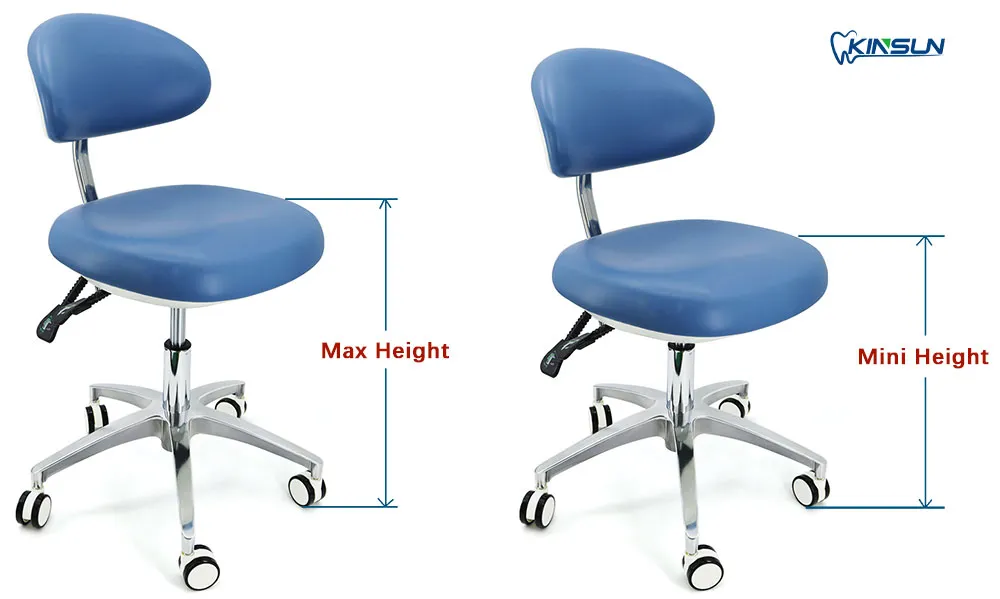
For example, a dental stool with a 20 cm gas-lift stroke does not automatically have a minimum height of 40 cm and a maximum height of 60 cm. Its actual height depends on the compressed length of the gas lift, how deeply it is inserted into the base, the height of the seat mechanism, cushion thickness, caster size and other structural details.
Therefore, the best specification for comparing adjustable dental stools is the complete floor-to-seat range—not the cylinder stroke alone.
Why Correct Dental Stool Height Matters
A difference of only a few centimeters can change the position of the operator’s hips, knees, feet, shoulders and working arms.
When a dentist stool is too low, the knees may rise to the same level as or above the hips. This closes the angle between the thighs and torso, encourages the pelvis to rotate backward and makes it easier for the lower back to round. The operator may then lean forward to reach the patient.
When a stool is too high, the feet may lose stable contact with the floor. The user may feel pressure under the thighs or slide toward the front of the cushion. A dentist may also compensate by pointing the toes downward or placing excessive weight on one foot.
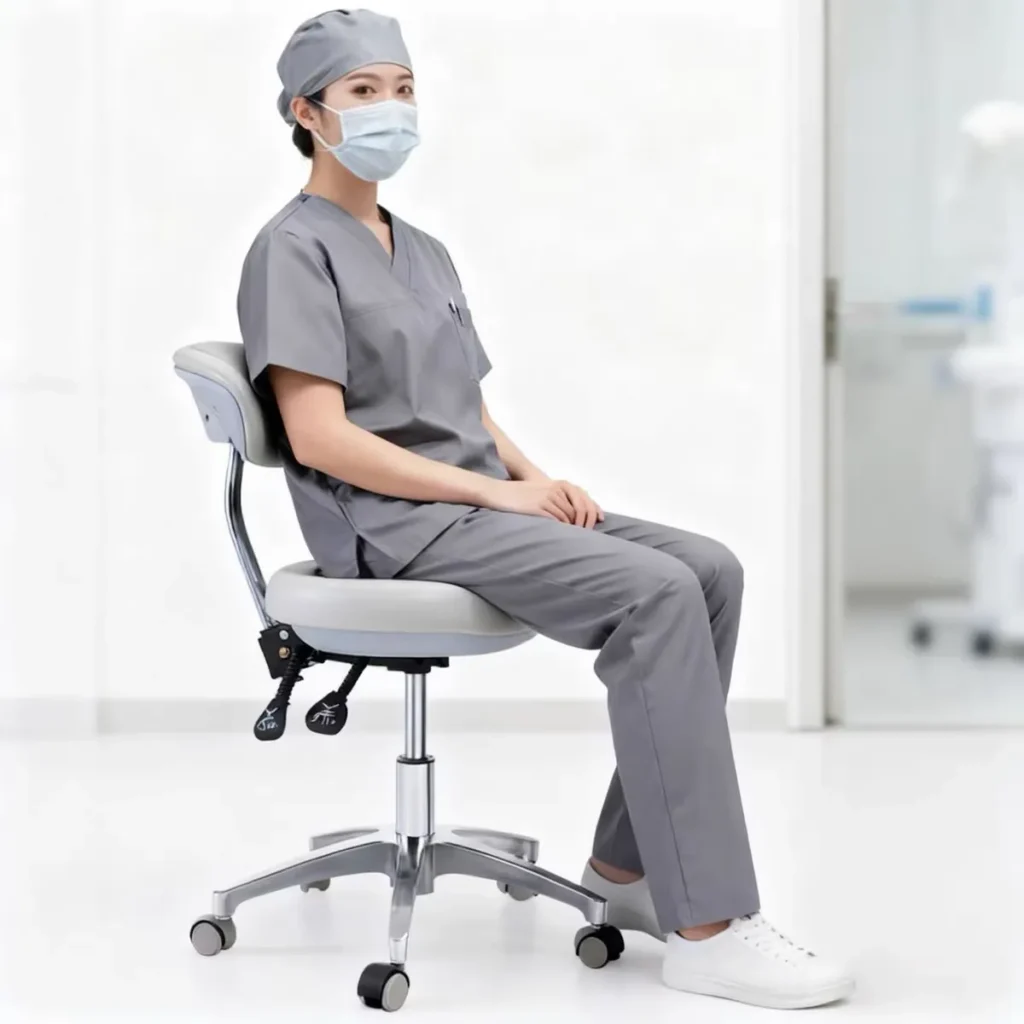
An appropriate stool height should help the clinician maintain:
- Hips slightly higher than the knees;
- Stable support through both feet or a correctly positioned foot ring;
- A relatively upright torso;
- Relaxed shoulders;
- Upper arms close to the body;
- Forearms near the clinical working level;
- Easy access to the patient without excessive forward bending.
The FDI World Dental Federation’s ergonomics guidance recommends beginning around knee height, keeping the hips slightly higher than the knees and placing both feet flat on the floor. It also recommends positioning the rheostat so the knee remains at approximately 90°–100° and limiting head inclination to approximately 15°–20° where possible. FDI ergonomics and posture guidance
Research on dental operating posture also describes a minimum angle of approximately 105°–110° between the thighs and torso. This is why the old advice to sit with the hips and knees at an exact 90° angle is not always suitable for prolonged dental work. Research on dental operating posture
How to Measure the Starting Height for a Dental Operator Stool
A buyer should not rely only on the operator’s total body height. Two dentists who are both 175 cm tall may have different leg and torso proportions.
A more relevant measurement is popliteal height: the vertical distance from the floor to the back of the knee while the person is seated with the knees at approximately 90°.
A practical measurement method
- Ask the user to wear normal clinical work shoes.
- Sit on a firm, level surface.
- Keep the lower legs approximately vertical.
- Place both feet flat on the floor.
- Keep the knees at approximately 90° during measurement.
- Measure vertically from the floor to the crease behind the knee.
- Use this measurement as a starting point—not an automatic final seat height.
- Test a slightly higher position until the hips are above the knees without losing stable foot support.
For a traditional flat-seat dental stool, the initial seat height may begin near the user’s shoe-adjusted popliteal height. The operator can then raise the stool gradually, often testing approximately 2–5 cm above that starting point, until the thighs slope gently downward and the torso-to-thigh angle opens.
The final setting should be determined by posture and stability rather than by a formula alone.
Anthropometric Data Show Why One Height Does Not Fit Everyone
Human body dimensions vary substantially. NIOSH anthropometric data provide a useful illustration:
| Population percentile | Female popliteal height | Male popliteal height |
|---|---|---|
| 5th percentile | 36.0 cm / 14.17 in | 39.7 cm / 15.63 in |
| 50th percentile | 39.3 cm / 15.47 in | 43.9 cm / 17.28 in |
| 95th percentile | 44.3 cm / 17.44 in | 48.3 cm / 19.02 in |
From the 5th-percentile female value to the 95th-percentile male value, the difference is approximately 12.3 cm.
This particular dataset was collected from US truck drivers, not dental professionals, so it should not be treated as a universal dental stool sizing chart. However, it clearly demonstrates why an adjustable dental stool must accommodate different body dimensions. NIOSH anthropometric study
For international distributors, local population characteristics also matter. A stool configuration developed for one country may not provide the most useful range for another market. Buyers should consider the shortest and tallest expected users rather than ordering around only the average person.
Ideal Dental Stool Height for Dentists
There is no single ideal dental stool height in centimeters. For a dentist, the right height is the position that supports a neutral posture while allowing close access to the patient.

The following numerical targets provide a more useful reference than simply saying “sit high” or “sit low”:
| Posture element | Practical target |
|---|---|
| Torso-to-thigh angle | At least approximately 105°–110° |
| Hips | Slightly higher than the knees |
| Foot-control knee angle | Approximately 90°–100° |
| Head inclination | Preferably within approximately 15°–20° |
| Feet | Flat on the floor or properly supported |
| Thigh position | Level to gently downward, depending on stool type |
| Shoulders | Relaxed rather than elevated |
| Upper arms | Close to the torso |
The dentist should set the operator stool before bringing the patient’s mouth into the working position. Once the doctor is seated correctly, the patient chair and headrest should be adjusted to meet the operator.
A common mistake is lowering the stool because the patient is too low. This may improve visibility temporarily, but it can close the hip angle and cause the dentist to round the back. In most cases, it is better to keep the operator in a stable posture and reposition the patient chair.
For more general purchasing factors, see our guide to choosing the best dental stool.
Dental Hygienist Stool Height
Dental hygienists frequently move between the 8, 9, 10, 11 and 12 o’clock working positions around the patient’s head. They may also spend long periods performing scaling and polishing procedures.
The correct dental hygienist stool height should allow the hygienist to:
- Move close to the patient chair;
- Keep the hips slightly above the knees;
- Maintain stable foot contact;
- Rotate around the patient without repeatedly twisting the spine;
- Keep the elbows near the torso;
- Avoid raising the shoulders to reach the mouth.
A traditional operator stool can begin near the hygienist’s popliteal height and then be adjusted upward in small increments. If the hygienist’s feet begin to lift from the floor, the setting is too high unless an appropriate foot support is provided.
Saddle seating is another option, but it usually places the user in a higher and more open sitting position. As a result, a stool that provides sufficient height for a traditional seat may not cover the same user’s preferred saddle position.
Not everyone adapts comfortably to saddle seating. Seat width, saddle shape, hip mobility, working habits and the patient chair all affect the result. Our best saddle chair for dental hygienists guide explains how to evaluate these factors.
Dental Assistant Stool Height
Dental assistants have different visibility and access requirements from dentists. During four-handed dentistry, the assistant needs to observe the oral cavity, manage suction and transfer instruments without continuously leaning around the operator.
A commonly used starting guideline is to position the dental assistant approximately 4–6 inches above the dentist. This equals:
- 4 inches = 10.2 cm;
- 5 inches = 12.7 cm;
- 6 inches = 15.2 cm.
The exact reference may be described as the seating or viewing position, depending on the training system. It should therefore be treated as a practical adjustment range rather than an inflexible measurement. Dental teaching guidance commonly uses the 4–6-inch difference to help the assistant gain better visibility. University of Queensland positioning guidance
Because the assistant sits higher, direct foot contact with the floor may be impossible. An assistant stool should therefore include an adjustable foot ring or foot platform. The foot support should carry part of the lower-body load and prevent the legs from hanging freely.
The assistant should also check that:
- The thighs are approximately level or slope slightly downward;
- The foot ring is high enough to support both feet;
- The torso support contacts the body below the ribs rather than pressing against the abdomen;
- The shoulders remain relaxed during suction and instrument transfer;
- The stool can move close to the patient without colliding with the dentist’s stool.
A clinic should not assume that the same height range will be equally suitable for the dentist and the assistant. The two roles have different working positions, which is one of the important distinctions explained in our dentist stool vs dental assistant stool comparison.
Dental Stool Height for Microscope Dentistry
Microscope dentistry is sometimes described as requiring a “high stool,” but height alone is not the real objective. The goal is to align the microscope, operator, patient and working point while the clinician maintains a neutral posture.

The correct setup sequence is:
- Adjust the dental stool for the operator’s body.
- Place the pelvis in a balanced position with the hips above the knees.
- Keep the torso upright and the head aligned over the shoulders.
- Allow the arms to remain close to the body.
- Raise, lower or reposition the patient chair.
- Adjust the patient’s head position.
- Bring the microscope and eyepieces to the operator.
- Confirm that the image remains clear without bending the neck toward the eyepieces.
The operator should not select an uncomfortable stool height simply to reach a microscope that was positioned first. The microscope should be brought to the clinician’s neutral working posture.
A longer adjustment range can be helpful in a shared microscope operatory, especially when several dentists of different heights use the same station. However, a 20 cm gas-lift stroke is not automatically the correct choice for every microscope user. The complete system must be evaluated, including:
- Operator leg length;
- Traditional or saddle seating;
- Microscope eyepiece position;
- Objective and working distance;
- Patient chair movement range;
- Headrest design;
- Arm support;
- Foot-control position;
- Whether the stool is shared.
Microscope ergonomics guidance similarly emphasizes aligning the head, shoulders and hips and adapting the optical system to the clinician’s neutral posture. Microscope dentistry ergonomics guidance
Traditional Dental Stool vs Saddle Stool Height
Seat design changes how height is experienced. A traditional dental stool and a saddle stool should not be compared only by their floor-to-seat measurements.
| Factor | Traditional dental stool | Saddle dental stool |
|---|---|---|
| Sitting style | Conventional seated position | Straddled, more open-leg position |
| Hip position | Slightly above knees | Usually higher above knees |
| Thigh direction | Level to gently downward | More noticeably downward |
| Foot position | Usually flat on floor | Flat on floor or supported, depending on height |
| Starting height | Near popliteal height, followed by adjustment | Usually higher than a traditional seat |
| Cylinder consideration | Must cover the operator’s neutral range | May require additional usable height |
| Adaptation | Familiar to most users | May require gradual adaptation |
A saddle stool can help some clinicians move closer to the patient by reducing interference between the thighs and patient chair. However, it is not suitable for every dentist or hygienist.
The user should test saddle width, cushion contour and working position before making a large purchase. Read our detailed saddle stool vs traditional dental stool guide for a broader comparison.
Why Gas-Lift Stroke Is Not the Same as Final Dental Stool Height
Gas-lift stroke is an important product parameter, but it does not independently determine the minimum and maximum height of the finished stool.
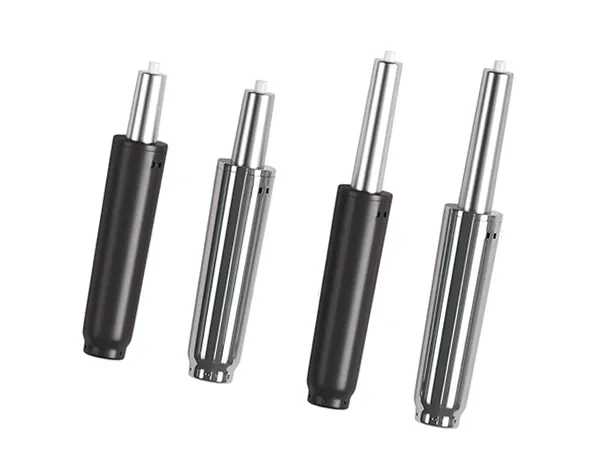
Kinsun Dental can configure stools with the following gas-lift strokes:
| Gas-lift stroke | Approximate inch conversion |
|---|---|
| 12 cm | 4.72 in |
| 14 cm | 5.51 in |
| 16 cm | 6.30 in |
| 20 cm | 7.87 in |
These measurements indicate the adjustment travel of the gas cylinder. They do not represent the complete floor-to-seat range.
The final dental stool height is affected by several components.
1. Compressed gas-lift length
Two gas lifts can provide a similar stroke while having different compressed body lengths. The cylinder with the longer compressed structure may create a higher minimum seat position.
2. Cushion thickness
Kinsun stools can use cushions with thicknesses such as 5.5 cm or 8 cm. The nominal difference between these options is 2.5 cm, which affects the floor-to-seat measurement.
However, foam compression should also be considered. The unloaded cushion height and the height experienced when a person is seated may differ according to foam density, cushion shape and user weight.
3. Caster diameter
Caster options may include diameters such as 5 cm or 6 cm. Caster size affects the base’s position above the floor, but a 1 cm difference in wheel diameter should not automatically be interpreted as a full 1 cm increase in seat height. The mounting structure and axle position also affect the actual result.
Caster selection influences more than height. Rolling resistance, floor type, stability and movement around the patient are also important. These factors are covered in our dental stool caster selection guide.
4. Five-star base structure
The shape and center height of the base affect how the gas cylinder sits above the floor. Different aluminum, steel or plastic base structures can produce different finished heights.
5. Cylinder insertion depth
Part of the gas lift enters the base, while the upper section connects to the seat mechanism. Different insertion depths can change the installed height, even when the cylinder specifications appear similar.
6. Seat mechanism and cushion shape
A traditional flat seat, one-piece saddle and split saddle do not position the pelvis in exactly the same way. Their seat plates, tilt mechanisms and cushion contours may also have different structural heights.
The correct formula is therefore not simply:
Gas-lift stroke = dental stool height range
A more accurate concept is:
Finished seat height = installed base and caster height + exposed gas-lift height + seat mechanism height + effective cushion height
Because some parts overlap during installation and the cushion compresses during use, the finished stool should be physically measured rather than calculated only from component catalog dimensions.
How Kinsun Matches the Required Dental Stool Height
Kinsun does not ask every buyer to select a 12, 14, 16 or 20 cm gas lift without considering the complete chair.
Instead, we begin with the customer’s required working range. Our team can then match the gas cylinder, cushion, casters, base and supporting structure to reach a more appropriate result.
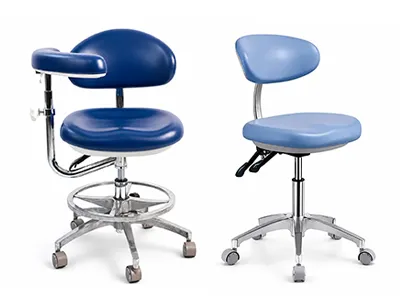
A practical matching process includes:
- Confirming the target minimum seat height;
- Confirming the target maximum seat height;
- Identifying the primary user;
- Reviewing the expected user height range;
- Confirming traditional or saddle seating;
- Checking whether a foot ring is required;
- Considering the patient chair and microscope;
- Selecting the gas-lift stroke;
- Matching cushion, caster and base options;
- Verifying the complete floor-to-seat range.
For example, a buyer may request a stool that adjusts from approximately 43 cm to 59 cm. This does not mean that a 16 cm cylinder can be selected automatically. Kinsun must first confirm whether the compressed cylinder length, cushion, casters and base can produce a finished stool that reaches both target measurements.
This approach is particularly useful for distributors serving markets with different body-size profiles or supplying a mixture of dentists, assistants and hygienists.
Explore the Kinsun adjustable dental stool range or contact us with your required minimum and maximum height.
Information Buyers Should Provide Before Ordering
To match an appropriate dental stool configuration, buyers should provide as much of the following information as possible:
- Required minimum floor-to-seat height;
- Required maximum floor-to-seat height;
- Whether measurements refer to an unloaded or occupied cushion;
- Primary users: dentists, hygienists or assistants;
- Approximate shortest and tallest user;
- Traditional seat or saddle seat;
- Single-user or shared workstation;
- Need for an adjustable foot ring;
- Need for backrest, arm support or torso support;
- Use with a dental microscope;
- Patient chair minimum and maximum movement;
- Preferred cushion thickness;
- Preferred caster size and floor type;
- Local market expectations;
- OEM color, upholstery, logo and packaging requirements.
The minimum and maximum seat heights are especially important. If a buyer provides only the user’s total height, Kinsun can offer an initial recommendation, but body height alone should not be treated as a final production specification.
Common Dental Stool Height Mistakes
Selecting by cylinder stroke alone
A 16 cm stroke describes cylinder movement, not the complete stool height. Always confirm the finished minimum and maximum seat-height measurements.
Using one configuration for every market
Average body dimensions and clinical preferences differ between countries. A distributor should consider the expected range of local users.
Giving dentists and assistants the same stool height
An assistant may need to sit approximately 10.2–15.2 cm above the operator. The stool must also provide adequate foot support at that position.
Ignoring cushion thickness
Changing from a 5.5 cm cushion to an 8 cm cushion affects the seat surface and may change how the user relates to the patient chair.
Applying traditional stool measurements to a saddle stool
Saddle stools usually place the pelvis higher and open the hip angle. They should be evaluated separately.
Raising the stool without supporting the feet
If the feet cannot reach the floor, a foot ring or platform is required. Unsupported legs can reduce stability and increase pressure under the thighs.
Adjusting the dentist to the microscope
The dentist should establish a neutral posture first. The patient chair and microscope should then be brought into alignment.
Measuring only the unloaded stool
A thick cushion may compress when occupied. Buyers should specify whether their required height refers to the unloaded seat surface or the approximate working height under load.
Forgetting caster and base geometry
Wheel diameter is only one part of the lower structure. Caster mounting and base design also influence the final height.
Frequently Asked Questions
There is no universal ideal height. Start near the user’s shoe-adjusted popliteal height, then raise the seat until the hips are slightly higher than the knees and the torso-to-thigh angle is approximately 105°–110° or more. Both feet should remain stable on the floor or an appropriate foot support.
Yes. Dental ergonomics guidance generally recommends placing the hips slightly higher than the knees. This helps open the hip angle and supports a more neutral pelvic and spinal position.
A commonly used starting range is approximately 4–6 inches, or 10.2–15.2 cm, above the dentist’s position. The assistant should then adjust the stool according to visibility, foot support, torso support and the clinical procedure.
No. A larger stroke provides more adjustment travel, but it may also be unnecessary for a particular stool or user. The correct choice depends on the required minimum and maximum seat height and the complete chair structure.
The nominal thickness difference is 2.5 cm, but the actual occupied height difference may be smaller because cushions compress. Seat shape, foam density and user weight influence the effective working height.
Not necessarily. Wheel diameter, axle position and mounting geometry all affect the installed caster height. The complete stool should be measured after assembly.
It often requires a higher working position than a traditional stool, but gas-lift stroke alone cannot determine the correct configuration. The saddle shape, user leg length, base and target floor-to-seat range must be considered together.
Set the stool according to the operator’s neutral posture first. Then adjust the patient chair, headrest and microscope. The best height is the one that allows the clinician to use the eyepieces without bending the neck, raising the shoulders or losing stable lower-body support.
Kinsun Dental offers 12, 14, 16 and 20 cm gas-lift strokes, along with different cushion, caster and structural options. We can recommend a configuration according to the buyer’s target minimum and maximum seat height, user profile and clinical application.
Choose the Right Height with Kinsun Dental
Dental stool height should be treated as a complete ergonomic system rather than a single cylinder specification. Gas-lift stroke, compressed cylinder length, cushion thickness, caster diameter, base structure and seat design all contribute to the usable floor-to-seat range.
Kinsun Dental can match 12, 14, 16 or 20 cm gas-lift strokes with different cushions, casters and stool structures. Whether you supply dentists, hygienists, assistants or microscope users, our team can help evaluate the target height range and recommend an appropriate configuration for your market.
Browse our Kinsun dental stools and contact us with your required minimum height, maximum height, preferred seat type and intended users. We will help you match the complete stool—not just one component.