

Choosing the right dental stool is about more than finding a comfortable seat. Dentists, hygienists and dental assistants frequently work in forward-leaning positions, move around the patient chair and maintain precise hand positions for extended periods. A poorly matched stool may restrict movement, make it harder to approach the patient and encourage unnecessary bending or twisting.

The best dental stool should fit the user’s body, clinical role, working height and treatment environment. It should provide a stable sitting position while allowing the operator to move freely between different working zones.
However, dental stools vary significantly in seat shape, height range, back support, cushioning, mobility and adjustment functions. A model that works well for a dentist may not be suitable for a dental assistant. Similarly, the softest or most expensive stool is not automatically the best choice.
This guide explains how to choose the best dental stool for an individual practitioner, dental clinic, distributor or OEM procurement project.
What Is a Dental Stool?
A dental stool is a mobile seat specifically designed for dentists, dental hygienists, assistants and other oral healthcare professionals. Unlike a conventional office chair, it must support frequent movement and allow the user to get close to the patient without the seat, backrest or base interfering with the dental chair.
Common features of a dental stool include:
- Pneumatic height adjustment
- A compact seat and mobile base
- Smooth-rolling casters
- Easy-to-clean upholstery
- Optional back or lumbar support
- Optional seat tilt adjustment
- Optional arm, torso or foot support
- A structure suitable for repeated clinical use
Dental stool must work as part of the complete treatment area. Its design should be considered together with the patient chair, delivery system, operating light and instrument position.
The American Dental Association highlights workplace ergonomics as an important concern in dentistry and recommends considering the operator’s height, body size and lumbar curvature when selecting a stool. A suitable stool cannot correct every clinical posture problem, but it can make neutral, balanced positioning easier to maintain.
Why Choosing the Right Dental Stool Matters
Dental procedures require concentration and precision within a relatively small working area. To obtain a clear view of the oral cavity, practitioners may be tempted to lean too far forward, lift their shoulders or rotate their upper body.
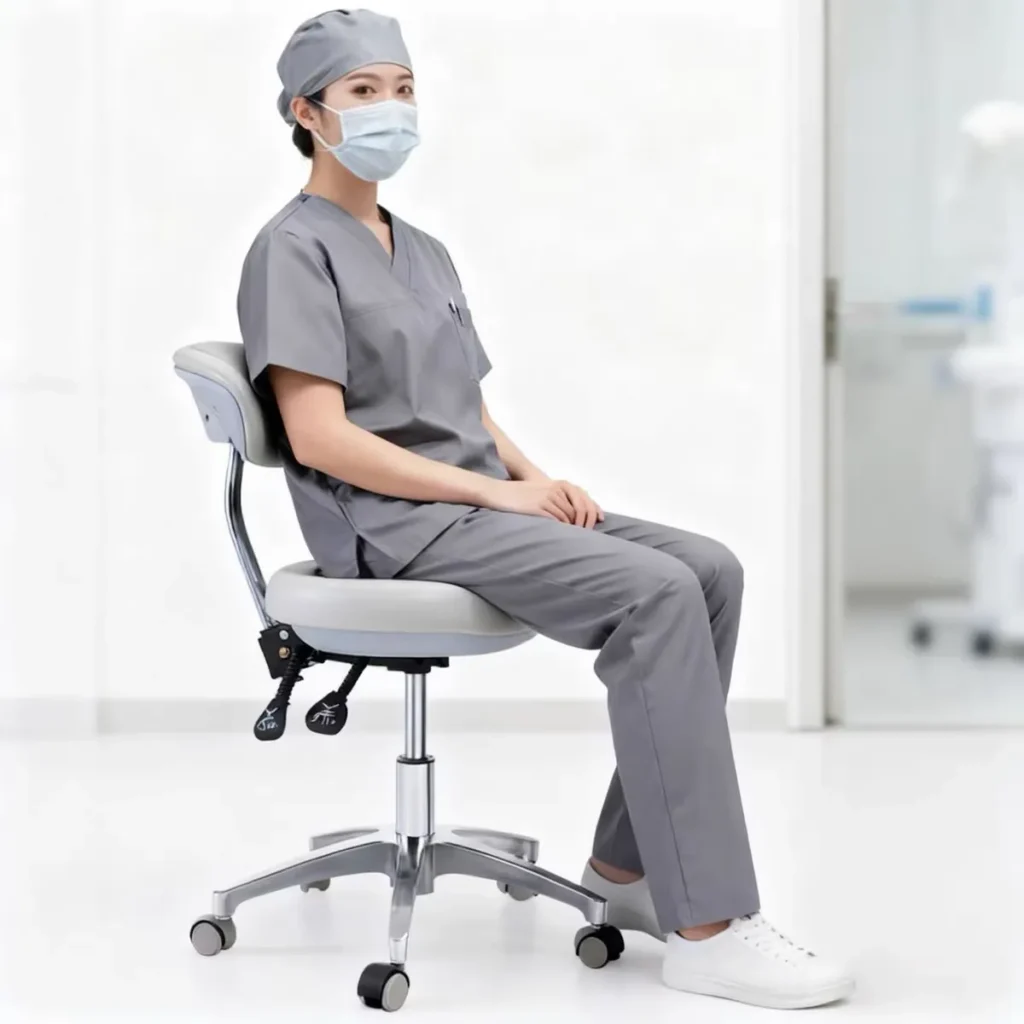
These movements can also be influenced by other factors, including patient positioning, lighting, instrument location and magnification. Nevertheless, the dental operator stool establishes the base from which the practitioner works.
A properly selected stool can help the user:
- Maintain a stable working position
- Keep the feet supported
- Move closer to the patient
- Change operating positions smoothly
- Reduce unnecessary reaching
- Maintain a more natural relationship between the hips, legs and spine
- Work comfortably during procedures of different lengths
The goal is not to force everyone into one “perfect” sitting posture. Dental professionals vary in height, body proportions and working technique. The goal is to select a stool that can be adjusted to the individual rather than requiring the individual to adapt to a poorly fitting seat.
Start by Identifying the Primary User
Before comparing upholstery colors or seat styles, determine who will use the stool. A dentist, hygienist and assistant may work at different heights and require different forms of support.
Dental Operator Stool
A dental operator stool is primarily used by dentists and other clinicians working close to the patient’s oral cavity. It should allow the operator to move around the dental chair and position their legs comfortably beneath or beside the patient chair.
Important features may include:
- A compact seat
- An appropriate height range
- Easy height adjustment
- Smooth multidirectional movement
- Adjustable lumbar or back support
- An optional tilting seat
- A base that does not obstruct close positioning
Operators who regularly move between different treatment positions may prefer a stool with minimal upper-body restrictions.
Dental Hygienist Stool
Dental hygienists often remain seated for extended procedures and may frequently change their angle around the patient. They need a stool that combines mobility with consistent support.
Depending on the user’s preference, an ergonomic dental stool for a hygienist may have a contoured seat, saddle-style seat, adjustable backrest or arm support. The user should be able to adjust the stool without interrupting the workflow.
Dental Assistant Stool
A dental assistant commonly sits higher than the operator to maintain visibility of the treatment area and transfer instruments efficiently. An assistant stool may therefore require:
- A taller gas cylinder
- A wider height adjustment range
- A height-adjustable foot ring
- A backrest or torso support
- A stable base
- A seat that remains comfortable at an elevated position
Using a standard dentist stool for an assistant may leave the assistant too low or without adequate foot support. Clinics should evaluate these two roles separately instead of ordering one stool design for every workstation.
Compare the Main Types of Dental Stools
Understanding the main stool designs will make it easier to narrow down suitable models.
| Dental stool type | Main advantages | Possible limitations | Suitable applications |
|---|---|---|---|
| Traditional round stool | Compact, economical and easy to move | Limited support and fewer adjustment options | Short procedures, laboratory work and budget-focused clinics |
| Contoured operator stool | Offers a larger, shaped sitting surface | An oversized seat may restrict close access | General dentistry and daily clinical use |
| Stool with backrest | Provides lumbar or back support | A poorly positioned backrest may push the user forward | Longer procedures and users who prefer supported seating |
| Saddle dental stool | Encourages a more open hip position and dynamic movement | May require an adaptation period | Dentists and hygienists who prefer upright, active sitting |
| Assistant stool with foot ring | Supports elevated sitting and stable foot placement | Usually has a larger footprint | Dental assistants |
| Stool with arm or torso support | Supports the upper body during detailed work | Incorrect adjustment may restrict movement | Precision procedures and selected assistant applications |
No single design is best for every user. Buyers should compare each type in relation to the actual clinical task.
Traditional Dental Stools

Traditional stools usually have a round or contoured seat and may be supplied with or without a backrest. Their familiar design makes them easy to introduce into most clinics.
A basic round stool is often compact and economical, but it provides limited positioning support. A contoured model may distribute pressure more evenly, although the seat should not be so large that it prevents the operator from approaching the patient.
Traditional stools are suitable for clinics seeking a practical balance between mobility, comfort and cost. Models with adjustable backrests and seat tilt provide more flexibility than basic fixed-seat designs.
Saddle Dental Stools
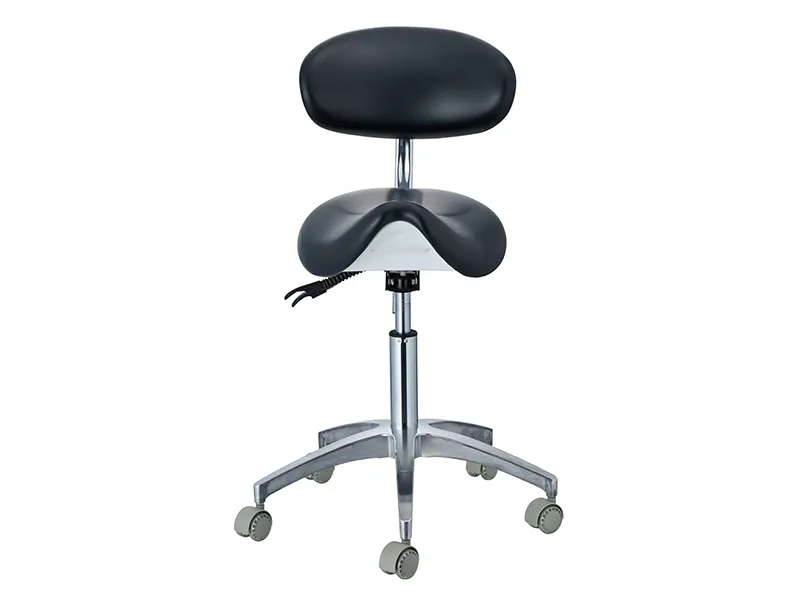
A saddle dental stool uses a seat shaped similarly to a riding saddle. It positions the legs in a more open arrangement and may allow the hips to remain higher than the knees.
Some dental professionals prefer this position because it supports an active sitting style and makes it easier to move close to the patient. Nevertheless, a saddle stool may feel unfamiliar at first. Seat width, contour, height and tilt all influence the experience.
A saddle stool should be tested or evaluated carefully if possible. A model that is too wide may create pressure along the inner thighs, while a narrow or sharply contoured seat may not suit every user.
Users changing from a conventional seat may also need time to become accustomed to the different sitting position.
Dental Stools with Back Support
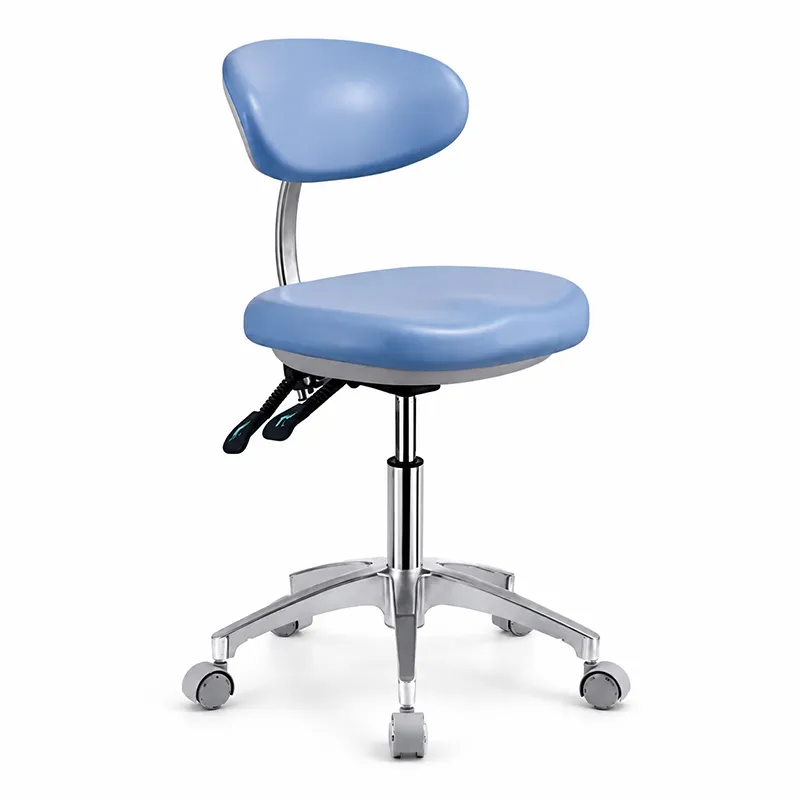
A backrest can provide valuable support, but only when it is correctly positioned. It should meet the user’s lower back or intended support area without forcing the body away from the patient.
Look for a backrest that can be adjusted in one or more directions:
- Up and down
- Forward and backward
- By angle
- By support tension
A small lumbar support can maintain mobility while providing a reference point for the lower back. A larger backrest may feel more supportive but could limit movement during procedures.
The choice between a stool with or without a backrest depends on the user’s working style. A backrest is not automatically beneficial if the operator sits on the front edge and never contacts it.
10 Factors to Consider When Choosing the Best Dental Stool
1. Match the Stool to the User’s Body
The best stool for dentists should accommodate the user rather than requiring awkward compensation. Consider the user’s:
- Overall height
- Leg length
- Hip width
- Preferred working position
- Need for back or arm support
- Typical duration of procedures
A short operator may need a lower minimum seat height, while a tall operator may require a longer gas cylinder. Seat depth is also important. If the seat is too deep, the user may not be able to contact the backrest without pressure behind the knees.
When buying for multiple employees, consider supplying different stool sizes or models instead of assuming that one standard configuration will fit everyone.
2. Check the Complete Height Adjustment Range
A product description stating that a stool is “height adjustable” does not provide enough information. Ask for its actual minimum and maximum seat heights.
When seated, the user should be able to establish a stable base without allowing the feet to dangle. The appropriate working height will depend on the operator’s body, patient position and clinical task.
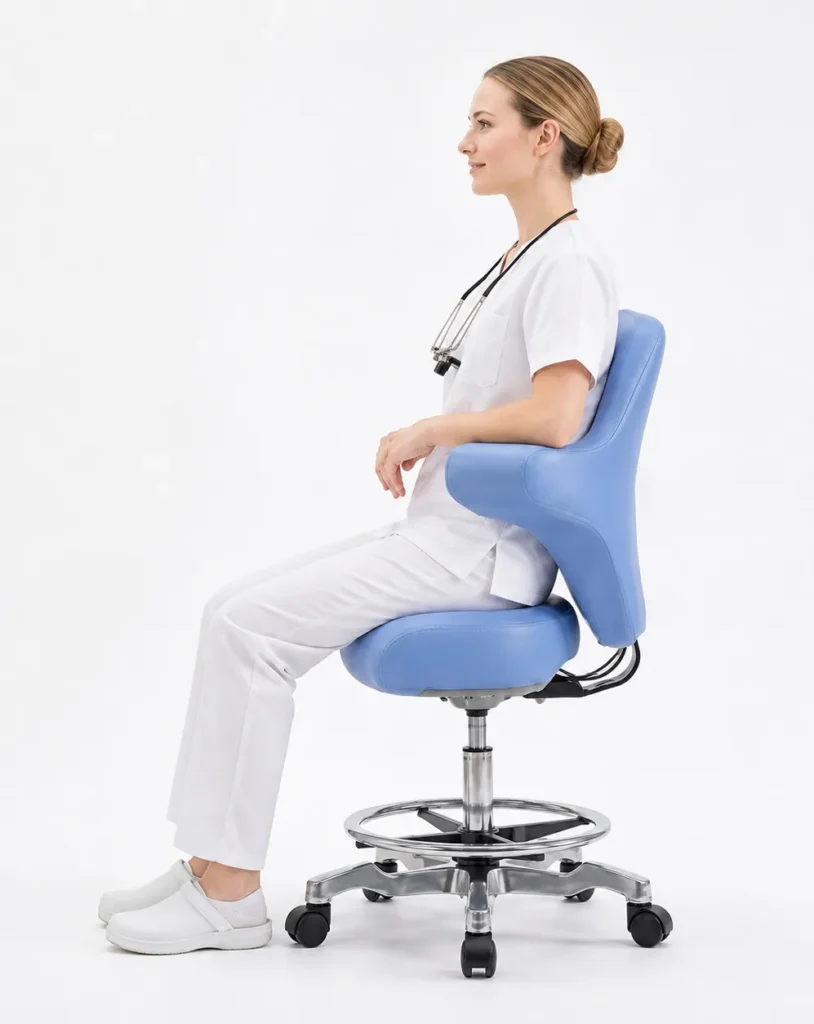
If the stool will be used by an assistant at an elevated height, select a model with a foot ring. The ring should be adjustable so that it supports the feet without creating excessive pressure under the thighs.
The height controls should also be accessible from the normal sitting position. A stool that is difficult to adjust is less likely to be set correctly between users or procedures.
3. Evaluate Seat Shape and Size
Seat shape affects weight distribution, leg position and access to the patient. Common options include:
- Round seats
- Flat seats
- Contoured seats
- Saddle seats
- Split saddle seats
A larger seat is not necessarily more comfortable. An oversized seat can restrict thigh movement and make it difficult to move closer to the dental chair. A very small seat, however, may not distribute the user’s weight adequately.
The front edge of a traditional seat should not create concentrated pressure behind the thighs. Rounded or waterfall-style edges may improve comfort for some users.
For saddle stools, compare the width and depth of the saddle instead of judging the product only by appearance.
4. Consider Seat Tilt
Some ergonomic dental stools allow the seat to tilt forward or change angle. A slight forward tilt may help certain users maintain an open hip position when leaning toward the patient.
However, excessive tilt can make the user feel as though they are sliding forward. The adjustment should be gradual, stable and easy to lock.
Seat tilt is particularly useful when different users share a stool, but it also introduces another control that must be set correctly. Clinics should provide basic adjustment guidance instead of expecting every user to discover the ideal configuration independently.
5. Decide Whether Back, Arm or Torso Support Is Needed
Different support systems serve different purposes:
- A lumbar backrest supports the lower back.
- A larger backrest supports a broader area.
- Adjustable armrests may reduce unsupported arm positions during selected tasks.
- A torso bar can support an assistant working at an elevated height.
Support components should not obstruct access to instruments, the patient chair or the delivery system. They must also be adjustable enough to match the user.
More support is not always better. A complicated stool with several fixed components can be less practical than a simple model with a well-positioned backrest.
6. Inspect the Cushion and Upholstery
A dental stool may be used for many hours each day, making cushion construction an important purchasing factor.
Very soft foam may feel comfortable initially but can compress excessively during long procedures. It may also lose its shape more quickly. High-density, resilient cushioning generally provides a more stable sitting surface.
The upholstery should be evaluated for:
- Wear resistance
- Surface texture
- Ease of cleaning
- Resistance to cracking
- Quality of stitching
- Number and location of seams
- Compatibility with the clinic’s approved cleaning products
Generally speaking, you should choose medical-grade PU or microfiber leather upholstery, avoiding standard PU or PVC materials. You can learn more by reviewing our information on upholstery materials for dental stools.
If a supplier describes upholstery as antimicrobial, medical-grade or disinfectant-resistant, ask for documentation supporting the claim.
7. Examine the Base and Casters
Most mobile dental stools use a five-point base because it offers a useful combination of stability and movement. The dimensions of the base should be appropriate for the treatment space.
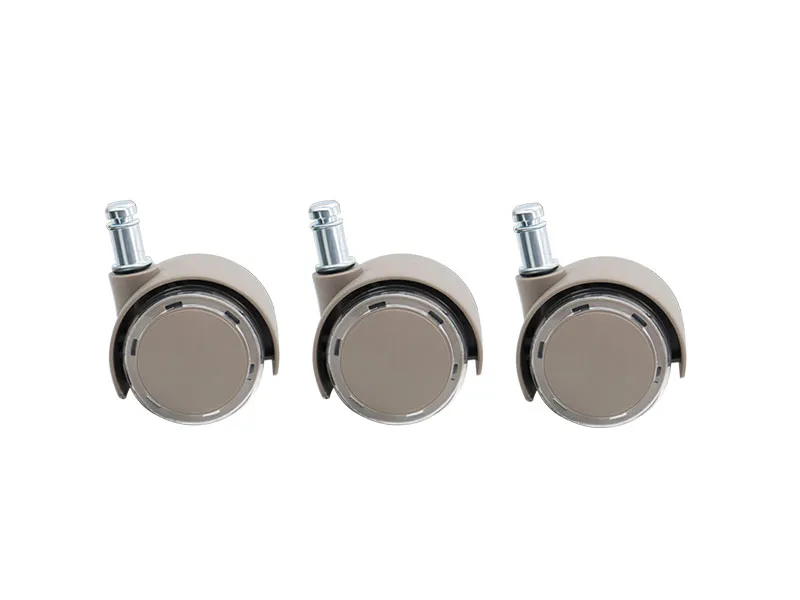
A very wide base may collide with the patient chair, delivery unit or assistant stool. A base that is too small may reduce stability, particularly at higher seat positions.
Casters should:
- Roll smoothly
- Rotate freely
- Operate quietly
- Match the clinic’s flooring
- Remain stable during clinical movements
- Be replaceable when worn
Soft and hard floor surfaces may require different caster materials. Buyers should tell the supplier whether the stool will be used on tile, vinyl, wood or another flooring type.
Casters should also be included in the maintenance plan. Hair, fibers and debris can collect around the wheel axles and reduce mobility.
8. Confirm Weight Capacity and Structural Stability
Always check the manufacturer-rated weight capacity rather than estimating it from the stool’s appearance. The rating should apply to the complete product, including the seat mechanism, gas cylinder, base and casters.
Other indicators of structural quality include:
- Minimal side-to-side movement
- Secure seat mounting
- Smooth pneumatic operation
- A stable adjustment mechanism
- A base suitable for the selected seat height
- Consistent welding or molded construction
- Availability of replacement components
For distributor and clinic orders, testing a sample can help identify unwanted movement, noise or inconsistent adjustment before a larger purchase is placed.
9. Consider Cleaning and Maintenance
Dental stools should be easy to clean around the seat, backrest, controls, base and casters. Complex seams and narrow gaps may collect dust or make routine cleaning more difficult.
Before purchasing, ask:
- Which cleaning products are recommended?
- Can the seat cushion be replaced?
- Are the casters removable?
- Can the gas cylinder be replaced?
- Are replacement backrests or adjustment handles available?
- What routine inspections are recommended?
The stool should be checked periodically for loose fasteners, damaged upholstery, caster obstruction, unusual movement and pneumatic lift problems.
A replaceable component can extend the useful life of a stool and reduce the cost of maintaining multiple treatment rooms.
10. Compare Warranty and Supplier Support
Product specifications are only part of the buying decision. Clinics and distributors should also evaluate the supplier’s ability to provide consistent products and replacement parts.
Important questions include:
- What does the warranty cover?
- How are warranty claims handled?
- Which parts are available separately?
- Can the supplier maintain consistent colors across repeat orders?
- Are assembly instructions provided?
- Is the stool delivered assembled or in parts?
- How is it protected during shipping?
- Can the supplier support mixed-model orders?
- Are OEM logo and packaging services available?
A low initial price may not represent good long-term value if replacement casters, gas lifts or cushions are unavailable.
Choose the Best Dental Stool in 5 Steps
A structured selection process can prevent purchasing decisions based only on appearance or price.
Step 1: Define the User and Clinical Task
Identify whether the stool is for a dentist, hygienist, assistant or laboratory technician. Record the procedures commonly performed and the amount of movement required.
Step 2: Determine the Required Working Height
Consider the user’s height, patient chair position and treatment layout. Confirm the actual seat height range with the supplier. If the user will sit at an elevated position, include a suitable foot ring.
Step 3: Select the Seat and Support Style
Compare traditional, contoured and saddle seats. Decide whether the user needs a backrest, arm support or torso bar.
Step 4: Test Positioning and Movement
When possible, test whether the user can:
- Place the feet securely
- Approach the patient without obstruction
- Maintain relaxed shoulders
- Move between working positions
- Reach instruments without excessive twisting
- Use the back or torso support as intended
If physical testing is not possible, request detailed dimensions, adjustment videos and clear product photographs.
Step 5: Evaluate Durability and Supplier Service
Compare the frame, gas cylinder, base, casters, upholstery and replacement-part availability. For bulk orders, consider purchasing a sample before confirming the complete quantity.
Common Mistakes When Buying a Dental Stool
Choosing Only by Price
A low-priced stool may be suitable for occasional use, but purchase cost should be evaluated together with adjustability, durability and replacement-part availability.
Assuming More Cushioning Means More Comfort
An extremely soft seat can reduce stability and compress during long procedures. Cushion density, shape and support are often more important than thickness alone.
Ignoring Minimum and Maximum Height
A stool can look correct in a photograph but still be too high or too low for the intended user. Always request actual measurements.
Using the Same Model for Dentists and Assistants
Assistants often require a higher stool and foot support. Ordering identical models for every treatment position may compromise workflow.
Selecting an Oversized Seat or Base
Large seats and bases can prevent the operator from getting close to the patient. Check the stool dimensions against the space around the dental chair.
Assuming a Backrest Will Automatically Improve Posture
A backrest only provides support when the user can reach it comfortably. Check its height, angle and forward adjustment.
Ignoring the Floor Surface
Casters that work well on one surface may move poorly or damage another. Confirm caster compatibility before ordering. Learn how to choose casters for dental stools.
Placing a Large Order Without Evaluating a Sample
For clinics, distributors and OEM buyers, a sample makes it possible to assess dimensions, upholstery, movement, assembly and adjustment quality before bulk production.
Buying Dental Stools for a Clinic
A clinic may not need the same stool in every room. Consider the treatments performed, room dimensions and people assigned to each workstation.
A practical clinic purchasing plan may include:
- Adjustable operator stools for dentists
- Supportive stools for hygienists
- Elevated assistant stools with foot rings
- Compact stools for laboratories or consultation areas
- A small number of alternative models for users with different requirements
Standardizing some components can simplify maintenance. For example, using compatible casters or gas cylinders across several models may make replacement easier.
Color coordination may also be important when stools are purchased together with dental chairs or cabinets. Buyers should request physical or well-calibrated color samples because colors displayed on screens may differ from actual upholstery.
Buying Dental Stools for Distribution or OEM Projects
Distributors need to evaluate both the end user’s requirements and the commercial practicality of the product range.
Instead of stocking many visually similar stools, a distributor can build a focused selection that covers distinct applications:
- An economical round stool
- A general operator stool with backrest
- A saddle dental stool
- An elevated assistant stool
- A premium model with additional support
Before importing dental stools, confirm:
- Packaging dimensions
- Unit and carton weight
- Assembly requirements
- Loading quantity
- Minimum order quantity
- Available upholstery colors
- Spare-parts packaging
- Branding options
- Instruction manual requirements
- Market-specific documentation
OEM buyers should define whether customization involves only the logo and packaging or also requires changes to the seat, base, gas cylinder, upholstery or adjustment mechanism. Clear specifications reduce the risk of inconsistencies between samples and production orders.
Why Consider Kinsun Dental Stools?
Kinsun Dental supplies dental equipment and accessories for clinics, distributors, repair service providers and OEM buyers. Our dental stool range is intended to support different treatment-room roles, including operator and assistant applications.

Depending on the selected model, available configurations may include different seat shapes, backrest designs, height ranges, bases, upholstery colors and support features. Buyers can compare models according to user height, clinical role, treatment-room layout and purchasing budget.
For distributors and private-label projects, Kinsun Dental can also discuss options such as logo application, color selection, packaging and mixed dental equipment purchasing. Spare-parts requirements and product specifications can be confirmed before an order is placed.
Explore Kinsun dental stools or send us your required quantity, preferred stool type, seat height and target market to receive a suitable product recommendation.
Frequently Asked Questions
The best dental stool is one that fits the dentist’s body size, working height and clinical technique. It should allow close access to the patient, stable foot placement and smooth movement. Useful features may include pneumatic height adjustment, a contoured or saddle seat and an adjustable backrest.
A saddle stool can be suitable for dentists who prefer an open hip position and dynamic sitting. However, saddle width, contour, height and tilt must fit the individual. Some users also require an adaptation period when changing from a traditional dental stool.
A backrest can provide useful lumbar or back support, especially during longer procedures. It should be adjustable and positioned close enough to contact the user without pushing them away from the patient. Some operators prefer a backless stool for greater freedom of movement.
There is no single correct height for every dentist. The height should allow stable foot support, comfortable leg positioning and close access to the patient. Buyers should compare the stool’s minimum and maximum seat heights with the user’s body dimensions and clinical setup.
A dentist stool generally prioritizes close patient access and movement around the treatment chair. An assistant stool is usually higher and may include a foot ring, backrest or torso support to help the assistant maintain visibility and transfer instruments.
The user should establish a balanced position with supported feet and relaxed shoulders. The stool, patient chair, light and instruments should be adjusted to reduce unnecessary bending, twisting and reaching. Because body proportions and procedures differ, the exact position should be adjusted for the individual.
Follow the stool manufacturer’s instructions and use cleaning products compatible with the upholstery and other surfaces. Wipe the seat, backrest, controls, base and casters regularly. Avoid unapproved chemicals that may cause discoloration, hardening or cracking.
Clinics should evaluate user roles, height ranges, treatment-room dimensions, upholstery, caster type, cleaning requirements, replacement parts and warranty support. Testing a sample before a large order can help verify comfort, movement, product dimensions and assembly quality.
Conclusion
Learning how to choose the best dental stool begins with understanding the person who will use it. The stool should match the user’s height, clinical role, preferred sitting style and working environment.
Compare more than price and appearance. Examine the seat shape, adjustment range, back support, cushion, base, casters, rated capacity and maintenance requirements. For clinic and distributor orders, supplier support, spare parts, packaging and product consistency are equally important.
The best dental stool is not necessarily the model with the most features. It is the one that provides the right combination of stability, mobility, adjustment and support for the intended user.
To compare suitable dental operator stools, assistant stools or customized purchasing options, contact Kinsun Dental for product specifications and a B2B quotation.